White Lotus Absolute on Skin: Dilution and Patch Tests
A drop of a rare floral on your skin at the end of the day sounds lovely, and it can be a pleasant way to wear a scent. It also deserves a little planning. White lotus absolute is a concentrated fragrance material, so the useful questions are how to dilute it, how to introduce it slowly and whether it suits you at all.
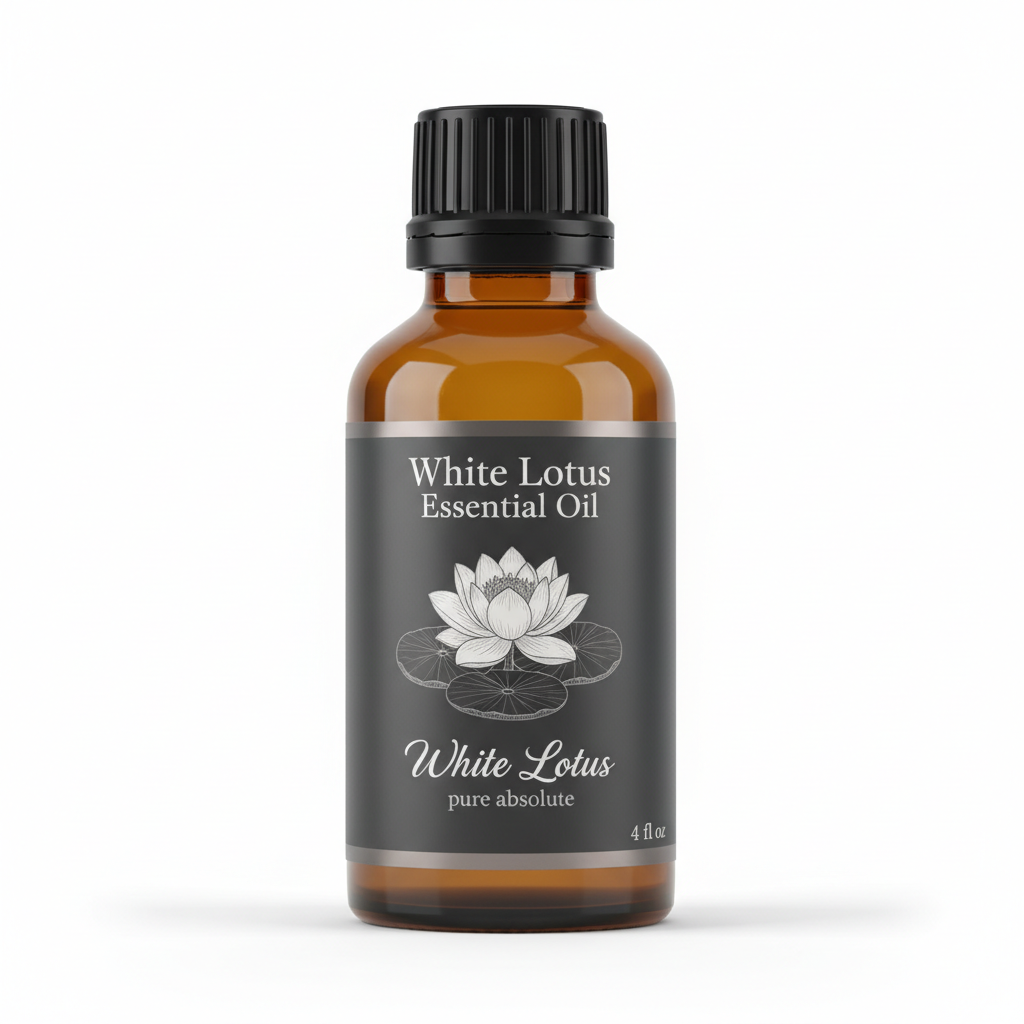
White Lotus Absolute
Our own White Lotus Absolute, in sizes from 0.5 oz to bulk.
From $23.99
Shop Now →Start with what we sell
We sell one product, a white lotus absolute that we describe as solvent-extracted and sell undiluted. We offer it for its aroma and make no claims about what it does for skin. Our guidance is 0.5% to 2% in a carrier oil such as jojoba or fractionated coconut, a patch test first and no contact with the eyes. The Certificate of Analysis we publish covers one batch and lists density, refractive index and optical rotation, so it cannot tell you which allergens a bottle contains. If you need species or allergen information first, ask us in writing through the contact page.
What research exists
Published lotus work is mostly lab and animal studies of water or alcohol extracts given by mouth, such as a 28-day rat study of an aqueous Nymphaea lotus flower extract (Kameni Poumeni et al., 2017). Those say little about a fragrance absolute on the face. The closest useful paper analysed an industrial blue lotus absolute and concluded that the available information "does not indicate major safety concerns for the topical application of authentic blue lotus flower concrete or absolute when diluted as a fragrance ingredient" (Dosoky et al., 2023). It is a reasonable starting point, with two things to keep in mind: the plant was a different species, and the authors work for an essential-oil company.
Our wider research map sets out what has been studied and how.
Why we go slowly on the face
With a fragrant concentrate, the thing to plan for is allergy rather than poisoning. Jasmine absolute, the best-studied floral absolute, gave positive reactions in 1.8% of 10,930 clinic patients patch tested to 12 essential oils (Geier et al., 2022). Those patients had already been referred to dermatologists, and lotus was not in the study, so the figure is a reminder rather than a prediction.
Timing matters too. In a series of 3,292 patients, 447 (13.6%) had a new positive reaction at the day-7 reading that was absent at day 3 (van Amerongen et al., 2019). That series was mostly about topical medicines rather than fragrance, but reasoning from it, we would watch a test spot for several days rather than a few hours.
Choosing the moment
Pick a quiet evening when you are not about to try anything else new. Wash your hands first, use clean tools and keep the test blend in a small labelled bottle you can find again in a week. A sticky label with the date and the percentage helps, because it is surprisingly easy to forget which version you made.
When you do wear it, use less than you think you need. A diluted floral absolute is a close, quiet scent, and a thin layer on one spot is plenty for a first try.
The arithmetic
These are working numbers, not a safe limit. One fluid ounce of carrier is 29.57 ml, and at roughly 20 drops per ml, 0.5% is about 3 drops, 1% about 6 and 2% about 12. An absolute is viscous, so weighing on a small scale beats counting drops. Because the composition is not published, our own suggestion for the face is to begin at the bottom of the range, use the absolute as the only scent in a plain carrier, and try it one evening at a time.

A sensible order of operations
- Make a small blend at the lowest dilution you can measure.
- Dab a little on the inner forearm and leave it alone for several days.
- If the spot stays calm, try a small amount on skin beside the jaw, away from the eyes.
- Stop at the first itch, redness or swelling.
Our dilution post and facial oil formulation work through the blending, and the safety basics cover patch tests.
What you may notice
Open the blend and smell it before it goes anywhere near skin. You should find the watery, honeyed floral we describe, lighter than the bottle suggested, since a low dilution turns the volume down. If it smells different from what you expected, that is useful to know. Wait a day and smell it again with a fresh nose before deciding anything.
Who should skip it
Anyone with a known fragrance allergy, a past positive fragrance patch test, or inflamed or eczema-prone facial skin should talk to a dermatologist or allergist first. Poison Control advises diluting essential oils in a carrier oil to avoid a bad reaction from direct skin contact (Poison Control). If you are pregnant or nursing, see our pregnancy and breastfeeding post and ask your midwife or physician.
Think of it as a perfume for the evening rather than a treatment. If your routine already works for you, nothing here says it needs a floral absolute, and the pleasure of a lovely aroma is reason enough to try it carefully.
White Lotus Absolute
White Lotus Absolute from our own shop, in sizes from 0.5 oz to bulk.
From $23.99
Shop Now →Sources & Further Reading
- Kameni Poumeni M et al., "Safety assessment of the aqueous extract of the flowers of Nymphaea lotus Linn (Nymphaeaceae): Acute, neuro- and subchronic oral toxicity studies in albinos Wistar rats." J Complement Integr Med, 2017
- Dosoky NS et al., "Chemical Composition, Market Survey, and Safety Assessment of Blue Lotus (Nymphaea caerulea Savigny) Extracts." Molecules, 2023
- Geier J et al., "Contact sensitization to essential oils: IVDK data of the years 2010-2019." Contact Dermatitis, 2022
- van Amerongen CCA et al., "New positive patch test reactions on day 7-The additional value of the day 7 patch test reading." Contact Dermatitis, 2019
- National Capital Poison Center, "Essential oils: Poisonous when misused"