Why Is Lotus Absolute So Expensive?
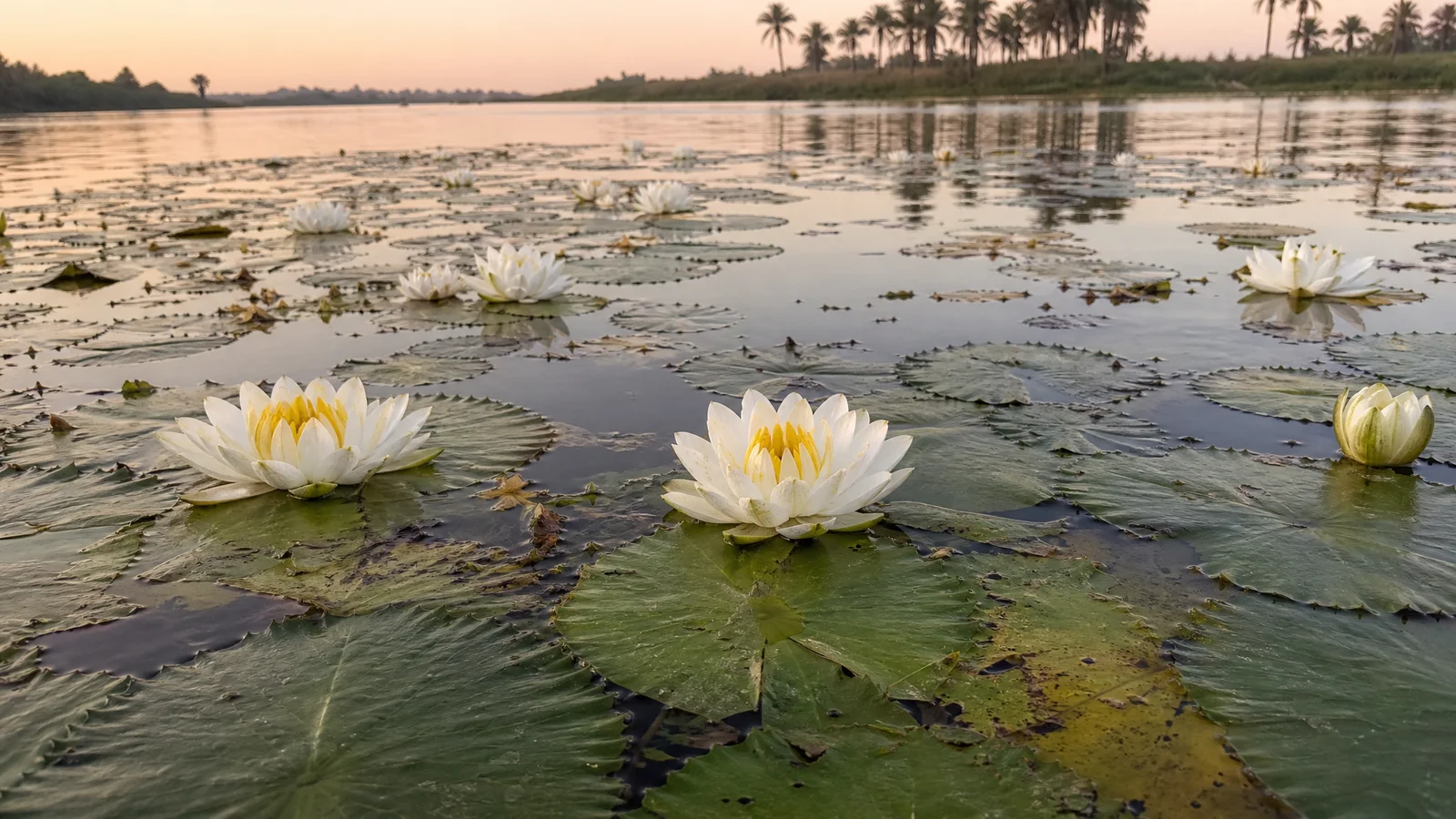
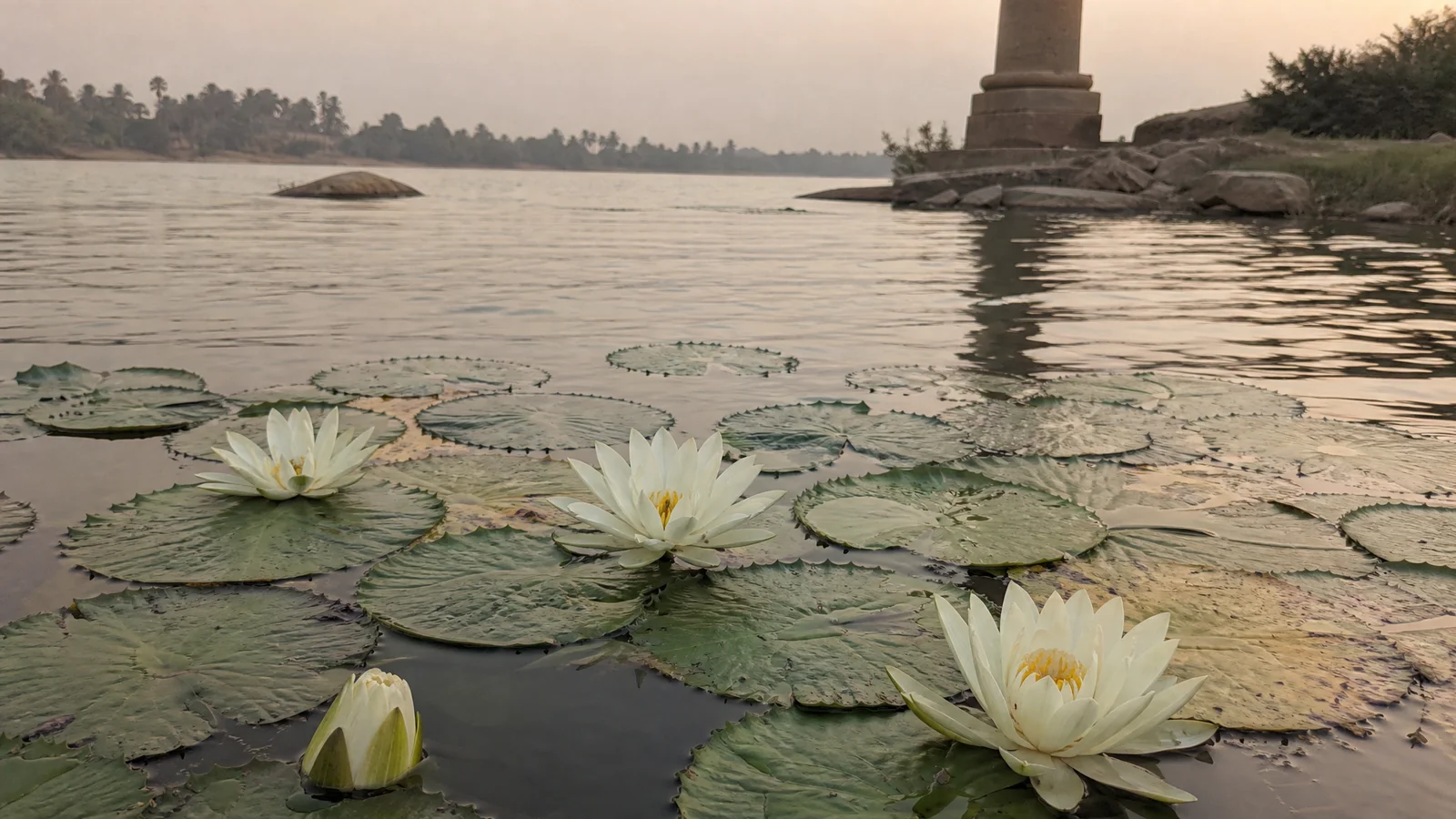
A kilogram of lotus absolute begins as a mountain of flowers. That one fact explains most of what a bottle costs, and it also explains why price on its own tells you very little about what is inside. Here is the arithmetic, the steps that add to it, and a better yardstick than the number on the tag.
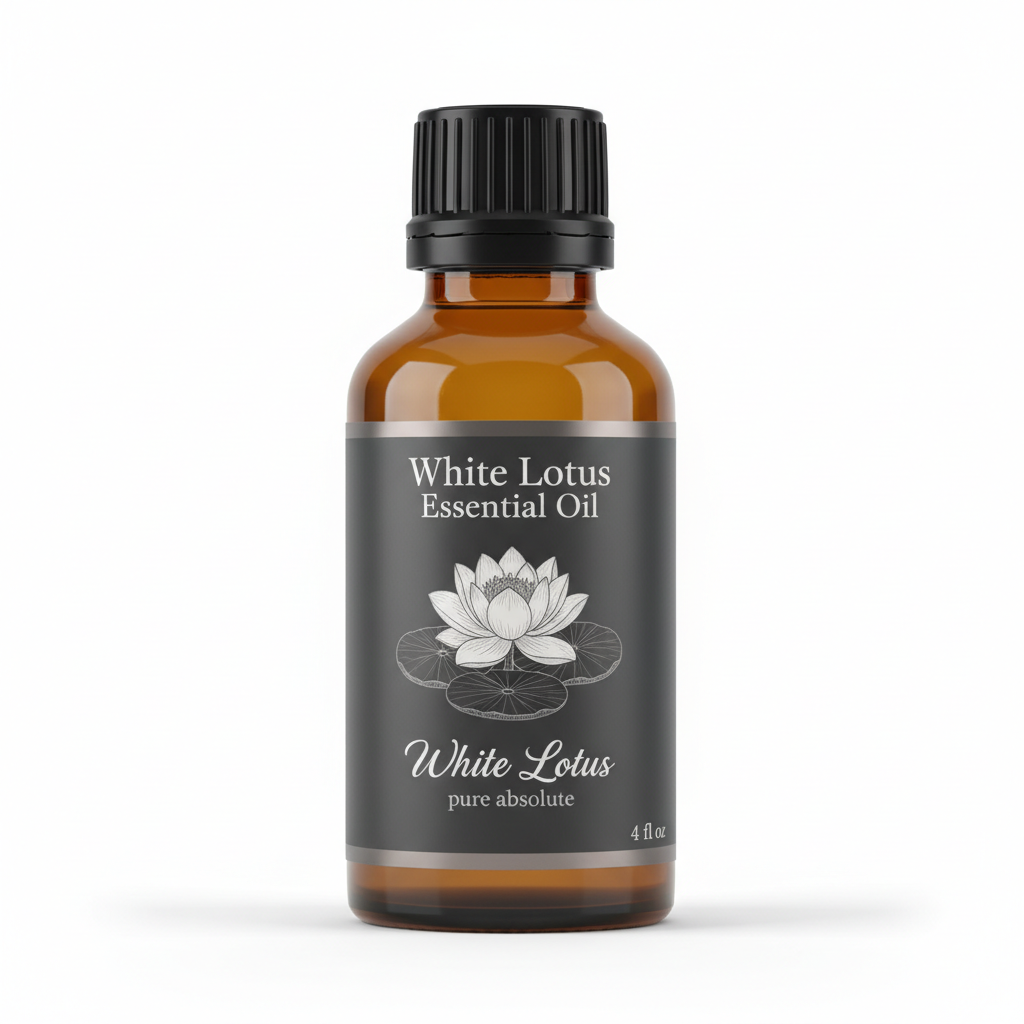
White Lotus Absolute
Our own White Lotus Absolute, in sizes from 0.5 oz to bulk.
From $23.99
Shop Now →A mountain of petals for a small bottle
The best published numbers come from a 2023 study of blue lotus (Nymphaea caerulea) grown in China, a related species, not the plant on our Certificate of Analysis. The team shredded about 1,000 kg of flowers, extracted them twice in hexane, stirring for 12 hours, and recovered the solvent to leave a waxy concrete. The yield was 0.18% concrete. They then washed the concrete in 95% ethanol, froze it for more than 12 hours so the waxes dropped out, filtered it and concentrated it. The absolute was 0.09% of the flower weight (Dosoky et al., 2023).
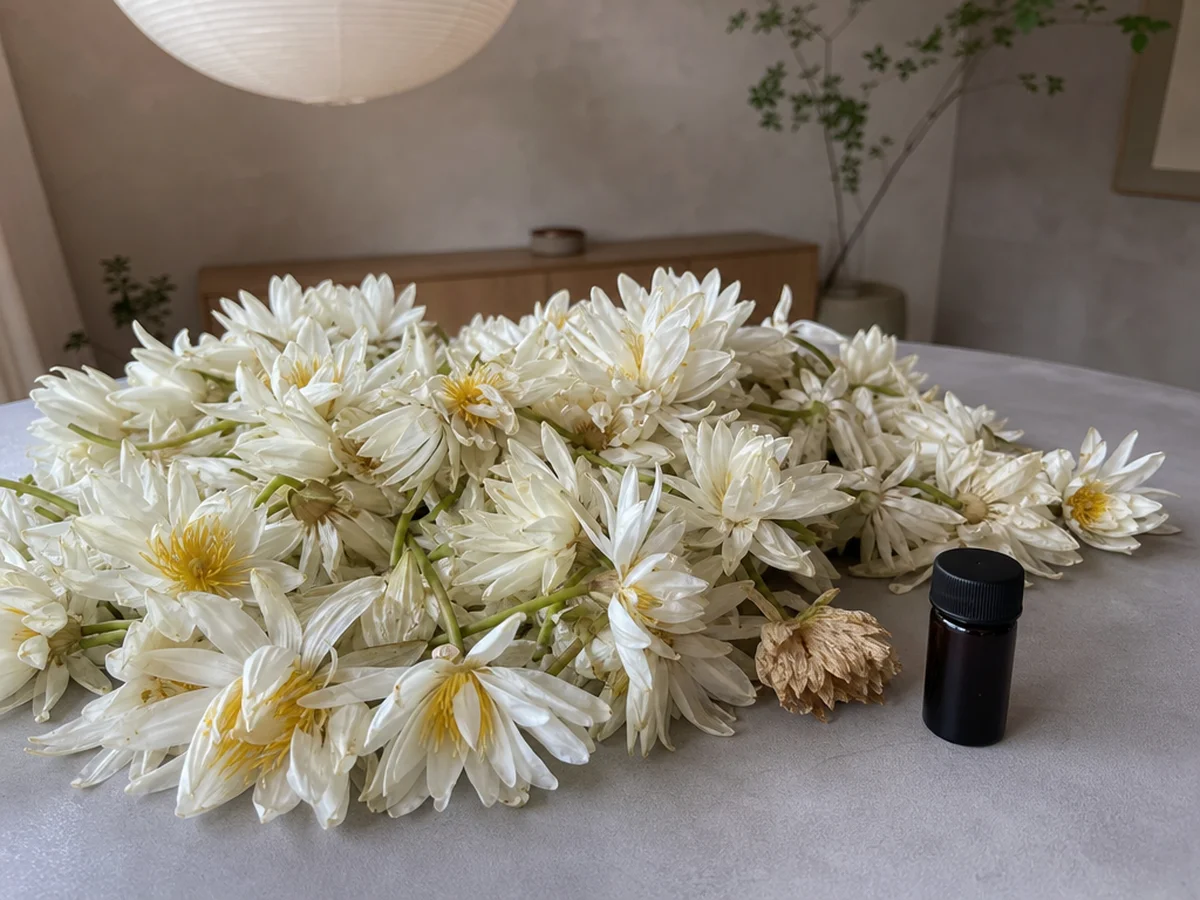
By our arithmetic, 1,000 kg of flowers gave roughly 1.8 kg of concrete and 0.9 kg of absolute, so a kilogram of absolute took on the order of 1,100 kg of flowers. That is one operation, so read it as one documented example, not an industry constant. For comparison, a laboratory-scale Egyptian study of four jasmine species reported concrete yields of 0.52% to 0.96% of flower weight, with absolute making up 39.67% to 61.28% of the concrete (Yassen et al., 2026). Multiplying through gives roughly 0.3% to 0.44% of flower weight, about three to five times the lotus figure. A lab soak is not a factory run, but the direction is clear: lotus gives up very little.
It is easy to forget how much work hides behind a small bottle. Think of the picking, the transport, the shredding, the long stirring, the waiting in the freezer, the filtering. Each stage asks for patience, and each is done on a scale that is hard to picture from a kitchen table. When you next hold a half-ounce bottle, it may help to hold it for a moment before you do any arithmetic.
Two extractions, a lot of patience
The steps in that study are the usual shape of an absolute: a first solvent extraction to a concrete, then an ethanol wash and a freeze to leave the waxes behind, then removal of the solvent. Each step needs equipment, time and labour. We describe our White Lotus Absolute as solvent-extracted.
It also helps to know what an absolute is made of. The blue lotus absolute in that paper was mostly waxes, fatty acids, alkanes, sterols and benzyl alcohol, and its volatile fraction ran from 38.7% to 65.1% of the whole extract. A perfumer pays for a material that smells distinctive at very small use levels, not for volume, which is why cost per bottle and cost per finished product are different numbers.
Why a price cannot vouch for a bottle
In the same paper, the researchers bought 11 products sold online as blue lotus. All of them contained synthetic fragrance components, none matched the authentic extracts, and the unidentified portion ran from about 2% to 33%. The study did not report prices, so it cannot tell us whether the lookalikes were cheap. It only shows that a lotus name on a listing is not proof of the contents. The reliable guide is paperwork and conversation: the species, the plant part, the extraction method, and whichever documents you need for your product. The batch certificate we publish lists density, refractive index and optical rotation for one batch. For anything beyond that, such as GC-MS or allergen information, ask us in writing through the contact page. Our guides on reading an absolute report and diluted and synthetic lotus oils show what to look for.
Spending it well
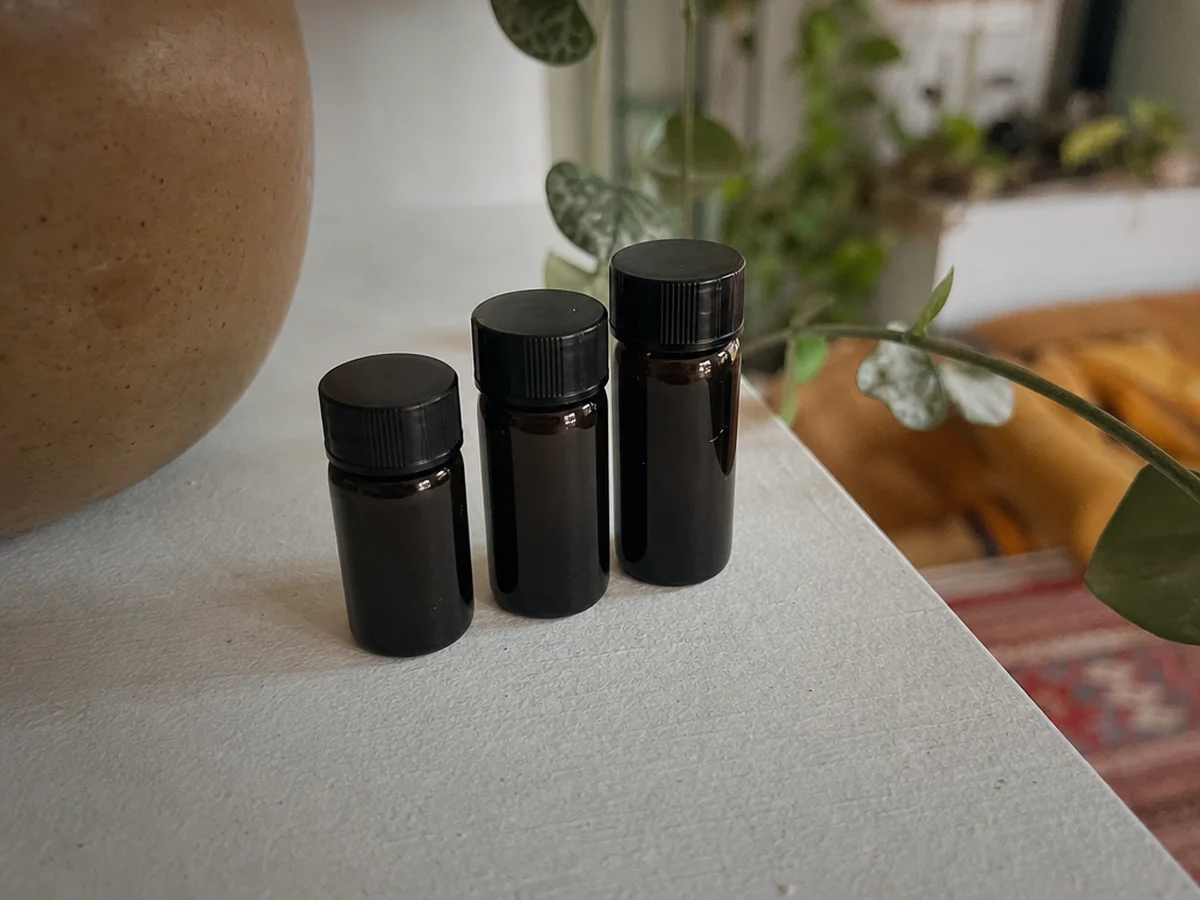
Our recommendation is to plan before you open the bottle. Decide what you want to make, write the recipe in grams, and calculate how much absolute it needs. A solid perfume tin, a small bottle of body oil and a scent card take only a trace each, so a single bottle can supply many small projects. Waste usually comes from rushing: a spilled pipette, a blend poured too strong, or a bottle left uncapped. Slow down, use a scale, and the bottle will last far longer than you expect.
Compare cost per finished product
You use an absolute in traces, so the better question is what it costs inside the thing you are making. Take a bottle's price and divide by its volume in millilitres to get a price per ml, which we will call P (a half-ounce bottle holds about 14.8 ml). Then, as arithmetic:
- One fluid ounce of finished product at 1% contains about 0.296 ml of absolute, so the absolute costs roughly P times 0.296.
- At 0.5% and 2%, multiply P by 0.148 and 0.591 instead.
- Per drop, divide P by about 20, a rough convention that varies by bottle.
Run those figures for every bottle you are weighing and the comparison usually becomes calmer. A smaller size is often the right choice for a single project, and our post on choosing a size by drops and grams shows how far a bottle stretches. Check the shop page for current prices.
A last practical thought: a smaller size is a good way to get to know any absolute before you commit to more. Smell it on paper over several days, try a small blend, and see how it fits your work. If it earns a place on your bench, you will know exactly how much you need next time.
The cost of lotus absolute reflects an unusually low yield and a multi-step process. Judge any individual bottle by the documents behind it and what it does for your blend, and you will spend your money where it counts.
White Lotus Absolute
White Lotus Absolute from our own shop, in sizes from 0.5 oz to bulk.
From $23.99
Shop Now →Sources & Further Reading
- Dosoky NS et al., 2023. Chemical Composition, Market Survey, and Safety Assessment of Blue Lotus (Nymphaea caerulea Savigny) Extracts. Molecules. pmc.ncbi.nlm.nih.gov/PMC10609367
- Yassen MS, Ayoub IM, El-Ahmady SH, Singab ANB, 2026. Comparative analysis of flower volatiles from four Jasminum species growing in Egypt using multivariate analysis. Sci Rep. pmc.ncbi.nlm.nih.gov/PMC12988214