White Lotus Uses: The Complete Guide to Perfume, Ritual, and Skin
Key Takeaways
- White lotus essential oil is extracted from Nymphaea lotus, the ancient Egyptian sacred flower, primarily through solvent extraction or CO₂ methods.
- Its scent profile is aquatic, warm, and softly floral: distinct from pink or blue lotus and irreplaceable in fine fragrance work.
- White lotus oil uses span three main areas: perfumery as a heart or base note, skin-supporting facial rituals, and contemplative ceremonial practice.
- True white lotus absolute and CO₂ are rare. Adulteration is common in the market, so sourcing transparency matters enormously.
- Proper dilution (typically 0.5–1% for facial application) and patch testing are non-negotiable safety steps for all topical use.
- No essential oil, including white lotus, is a substitute for professional medical advice or prescribed care.
Some ingredients arrive with centuries of meaning attached. White lotus is one of them. Cultivated along the banks of the Nile and revered in ancient Egyptian cosmology, Nymphaea lotus was pressed into ceremonial garlands, depicted on temple walls, and almost certainly worn as a scent long before the word "perfume" entered any language. Today, the white lotus essential oil benefits that drew ancient Egyptians to this flower are attracting a new generation of perfumers, skin-ritual enthusiasts, and people who simply want their evening routine to feel more intentional.
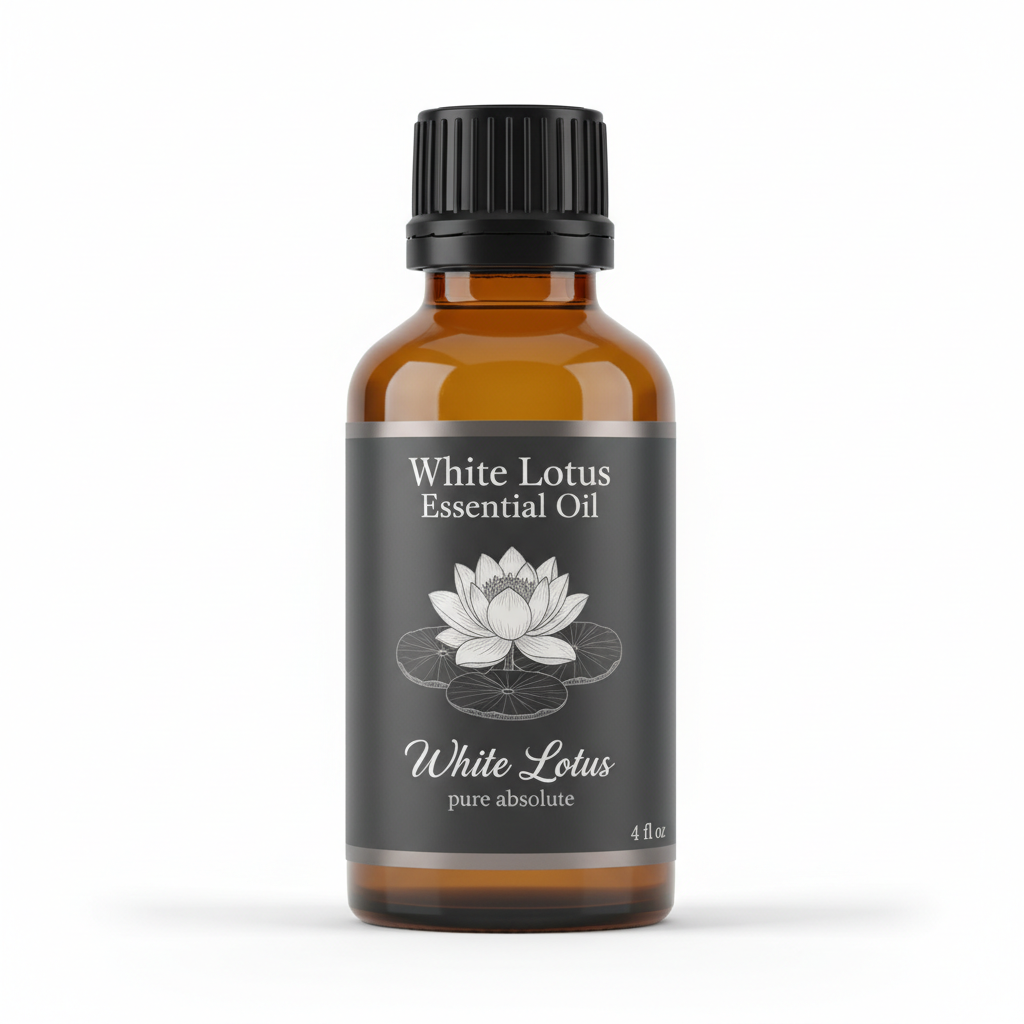
White Lotus Absolute
Our own White Lotus Absolute, in sizes from 0.5 oz to bulk.
From $23.99
Shop Now →This guide covers everything. You will learn what white lotus oil actually is (and what is often sold in its place), how its scent behaves in a blend, how to bring it into skin rituals safely, what the contemplative traditions say about its use, and how to find a genuinely high-quality product in a market crowded with synthetics and dilutions.
No mysticism without substance. No claims without context. Just an honest, detailed look at a genuinely extraordinary botanical oil.
1. What Is White Lotus Essential Oil?
The Botanical Source
Nymphaea lotus is a water lily native to the Nile Delta and parts of sub-Saharan Africa and South Asia. It is not to be confused with its more frequently discussed relatives. The blue lotus (Nymphaea caerulea) has a crisper, more aquatic character with faintly anise-like undertones. The sacred pink lotus (Nelumbo nucifera) is botanically a different genus entirely, with a powdery, rosy warmth that sits in a completely different olfactory territory. White lotus sits between these two: softer than blue, less powdery than pink, with a creamy, slightly musky depth that makes it uniquely valuable in complex fragrance compositions.
The flower blooms nocturnally, opening as temperatures drop and closing again before the heat of midday. This nocturnal quality carries a symbolic resonance that has made it meaningful across Egyptian, Hindu, and Buddhist traditions. It also has a practical implication for extraction: the aromatic compounds are most concentrated during the evening hours, which is why traditional harvests are timed accordingly.
Extraction Methods
Here is where white lotus gets complicated. The petals are extremely delicate and yield very little volatile oil. Steam distillation, the method used for most familiar essential oils such as lavender or eucalyptus, is poorly suited to white lotus. The heat damages or destroys many of the most characteristic aromatic compounds before they can be captured.
The two methods that produce commercially available white lotus oil are:
- Solvent extraction (absolute): The petals are washed with a chemical solvent, typically hexane, which draws out the aromatic compounds along with waxes, pigments, and other non-volatile material. The resulting "concrete" is then treated with alcohol to isolate the absolute. This method preserves the scent with remarkable fidelity. The trade-off is trace solvent residue, which is why white lotus absolute is generally not recommended for direct inhalation from a diffuser at high concentrations, though it is widely used in perfumery and diluted topical applications.
- CO₂ extraction (supercritical): Carbon dioxide under pressure acts as a solvent, drawing out aromatic compounds without heat. When the pressure is released, the CO₂ evaporates, leaving behind an extract that is considered cleaner than a traditional absolute. CO₂ extracts often have a truer-to-flower scent and are generally preferred for skin applications and aromatic diffusion.
Any product labeled "white lotus essential oil" that is priced similarly to lavender or eucalyptus should be approached with serious skepticism. Genuine white lotus absolute or CO₂ is labor-intensive to produce and priced accordingly. More on this in the sourcing section.
Key Aromatic Compounds
Research into the composition of Nymphaea lotus extracts has identified several notable compound groups, including terpenols, fatty acid derivatives, and a range of esters that collectively produce that signature creamy-aquatic-musky quality. Some analyses have also noted the presence of indole at trace levels, a compound that appears in jasmine and other white florals and contributes to the slightly animalic depth that makes white lotus feel rich rather than thin.
These compounds are responsible for the scent, and they are also the reason white lotus absolute requires careful dilution for skin use. Some constituents can be sensitizing at high concentrations, particularly for individuals with reactive skin.
2. Understanding the Scent Profile
The Olfactory Character of White Lotus
Describing any scent in words is an inherently imperfect exercise. But for blending and purchasing decisions, a working vocabulary helps. White lotus absolute can be described through several primary impressions:
- Aquatic-floral: There is a coolness to the opening, reminiscent of water and petals rather than sun-warmed greenery. This aquatic note makes it feel clean without being harsh.
- Creamy warmth: Beneath the initial aquatic impression, white lotus develops a soft, almost milky warmth. This is what separates it from more transparent water florals.
- Subtle musk: The drydown has a faintly musky quality, partly attributable to those trace indole compounds, that gives the scent longevity and a sense of skin-warmth.
- Low sweetness: Unlike many commercial floral fragrances, white lotus is not overtly sweet. Its sweetness is restrained, which is why perfumers prize it for adding depth without cloying.
Volatility and Perfume Notes
In perfumery classification, white lotus sits comfortably as a heart note, occasionally bridging into base note territory on the drydown. Its mid-range volatility means it emerges after the initial top-note burst of a fragrance and holds its character for several hours before the base notes dominate.
This heart-note position is exactly what makes white lotus oil so useful to both home blenders and professional perfumers. It provides the emotional center of a fragrance: the part that defines character and lingers in memory.
Comparison with Other Lotus Oils
| Oil | Botanical Name | Primary Scent Character | Typical Perfume Position |
|---|---|---|---|
| White Lotus Absolute | Nymphaea lotus | Aquatic, creamy, softly musky | Heart to base |
| Blue Lotus Absolute | Nymphaea caerulea | Crisp aquatic, faintly anise, transparent | Heart |
| Pink Lotus Absolute | Nelumbo nucifera | Powdery rose, warm, slightly earthy | Heart to base |
3. White Lotus in Perfumery
Why Perfumers Reach for White Lotus
White lotus essential oil benefits within a fragrance composition come down to one core quality: it connects. Specifically, it connects the fresh, volatile top notes of a composition to the heavier, slower-moving base notes without creating an awkward transition. In fragrance-making, this connective tissue is often the hardest thing to source. Many heart note florals are too sweet, too indolic, or too sharp to serve this bridging function gracefully. White lotus does it naturally.
The oil is used in a remarkably wide range of fragrance families. It appears in aquatic compositions where it deepens the watery impression. It appears in orientals where its creamy warmth provides contrast to resins and spices. It works in chypres, in clean musks, and in contemporary skin-scent compositions. Few natural florals are this genuinely versatile.
For a deeper exploration of how white lotus functions within a complete fragrance architecture, including note layering, fixative pairings, and composition ratios, see our dedicated guide to white lotus in perfumery: building an aquatic floral heart.
Classic Pairings in Perfume Composition
These are the accords that experienced perfumers return to repeatedly when working with white lotus:
- White lotus and sandalwood: The warmth of sandalwood amplifies the creamy drydown of white lotus while softening any sharp edges. This is one of the most reliable pairings in natural perfumery. Our own formulation built around this accord is detailed in the Nile Dawn blend.
- White lotus and frankincense: Frankincense adds a resinous, slightly citrus-edged top note that contrasts beautifully with the aquatic opening of white lotus. The combination has an ancient, ceremonial quality that suits meditation blends.
- White lotus and neroli: Neroli's bright citrus-floral quality gives white lotus a lift, preventing it from feeling heavy in warmer weather applications. The result is an unexpectedly sunny composition.
- White lotus and vetiver: Vetiver's smoky, earthy depth anchors the entire composition, taking white lotus's softness and making it last for hours. This pairing works particularly well in oil-based perfumes.
- White lotus and ambrette seed: Ambrette seed is a natural musk with a slightly nutty, pear-like quality. Paired with white lotus's trace indole musk, the two create an extraordinarily skin-close, intimate accord.
Usage Rates in Fragrance
White lotus absolute is potent. In alcohol-based eau de parfum compositions, a usage rate of 2–5% for the absolute is typical, depending on how prominent you want the lotus note. In oil-based perfumes (jojoba or fractionated coconut oil carrier), 1–3% is usually sufficient. These figures are starting points, not absolutes. The best approach is to make a small test batch, evaluate it over 24–48 hours on skin, and adjust accordingly.
Home blenders should note that white lotus absolute can be thick and difficult to measure in small quantities. Warming the bottle gently in your hands for a minute or two before measuring will improve pourability considerably.
4. White Lotus Oil Uses for Skin Rituals
The Cosmetic Case for White Lotus
The conversation around white lotus oil benefits for skin is growing, and for good reason. The oil contains naturally occurring compounds that cosmetic formulators have begun incorporating into premium skincare. Some research suggests that certain constituents found in Nymphaea extracts may support the appearance of smooth, luminous skin. It is worth noting that much of this research is preliminary, conducted in laboratory settings rather than large-scale clinical trials. The honest position is: white lotus has been used in traditional cosmetic practice for millennia, emerging science is beginning to explore why, and many people who incorporate it into a consistent facial oil ritual report that their skin looks and feels improved.
What we can say with confidence is that white lotus absolute, when properly diluted in a well-chosen carrier oil, adds a genuinely beautiful aromatic dimension to a facial oil routine. The scent itself has value. A skincare ritual that you actually look forward to, because it engages your senses meaningfully, is a ritual you will maintain consistently. Consistency is where cosmetic results actually come from.
For a complete formulation guide, including carrier oil selection and step-by-step application technique, see our article on DIY white lotus facial oil: one precious drop, well placed. And for a broader overview of where white lotus sits in a contemporary evening skincare sequence, our guide to white lotus for skin: a rare floral in your evening routine covers the full context.
Carrier Oil Pairings for Skin Use
White lotus absolute does not travel to skin alone. It must be diluted in a carrier oil. The choice of carrier matters significantly, both for skin compatibility and for how the final blend performs aromatically.
- Rosehip seed oil: Rich in linoleic acid and naturally occurring retinoids, rosehip is a popular choice for evening facial oils. It is deeply nourishing and absorbs well. The slightly nutty undertone of rosehip oil blends seamlessly with white lotus's creamy character.
- Jojoba oil: Technically a liquid wax, jojoba is extraordinarily stable and closely resembles the skin's natural sebum in composition. It has a very neutral scent, making it the best choice when you want the white lotus aroma to come forward cleanly.
- Marula oil: Light, fast-absorbing, and softly oleic, marula pairs beautifully with white lotus for a non-greasy evening face oil. It has a faintly floral, slightly nutty character of its own that complements rather than competes.
- Argan oil: Stable, dry-feeling on skin, and neutral in scent. An excellent everyday choice for a white lotus facial oil that will not feel heavy on combination skin.
Application Suggestions
The most common application for a white lotus facial oil is as the final step of an evening skin ritual, pressed gently into damp skin after a water-based serum has absorbed. Damp skin absorbs oil more efficiently than dry skin, and the slight moisture also helps carry the scent. Two to three drops of a properly diluted blend (see the safety section for dilution percentages) is usually sufficient for the full face and neck.
Some people also use a diluted white lotus blend as a décolletage or pulse-point oil, worn the way a perfume would be worn. At appropriate dilution rates, this is a legitimate and lovely use of the oil.
5. Ceremonial and Contemplative Uses
Historical Context
The ceremonial use of white lotus is not a modern wellness invention. In ancient Egyptian culture, Nymphaea lotus was associated with the sun god Ra and with the concept of creation emerging from primordial waters. Temple offerings routinely included lotus garlands. Aristocratic banquets depicted in tomb paintings show guests wearing lotus collars and holding lotus blossoms to their faces, breathing in the scent as part of ritual observance.
In Hindu and Buddhist traditions, the lotus generally (across species) represents the soul's capacity to rise toward clarity through difficulty. White lotus specifically carries associations with purity and the quality of open receptivity. These are not incidental details. They are the cultural inheritance that gives contemporary ritual use of white lotus its depth and resonance.
Diffusion and Room Atmosphere
White lotus absolute is not ideal for standard ultrasonic diffusers, primarily because of its thick consistency and (in the case of solvent-extracted absolutes) the trace residue considerations mentioned earlier. However, CO₂ extracted white lotus is considerably more diffuser-friendly. A few practical approaches:
- Gentle heat diffusion: A ceramic ring diffuser over a low-heat lamp, or a wax melt warmer set at low temperature, allows the oil to volatilize slowly without overheating the aromatic compounds. Place 1–2 drops of CO₂ extract in the dish.
- Reed diffuser blend: White lotus absolute can be blended into a reed diffuser base (typically dipropylene glycol or a light carrier oil) at 5–10% for room diffusion. The slow, passive volatilization is well-suited to white lotus's character.
- Fabric or cotton pad: For personal, close-range diffusion during a meditation practice or contemplative reading, a single drop on a cotton pad placed nearby is simple and effective. The scent radius is intimate rather than room-filling, which suits the inward quality of the oil.
For a fully developed ritual structure using white lotus as its sensory anchor, including timing, breath practice, and intention-setting suggestions, we have a complete guide to a meditation ritual with white lotus: stillness in a single drop.
Creating a Sensory Ritual Environment
The power of a scent-anchored ritual lies in association. The human brain encodes scent memories with unusual durability and emotional specificity. When you consistently pair a particular aroma with a particular practice, the scent begins to serve as an access point. Bringing white lotus into a dedicated evening wind-down sequence can, over time, help the mind recognize it as a cue for stillness.
This is not a health claim. It is an observation about how olfactory conditioning works, documented extensively in sensory psychology research. Fragrance professionals and contemplative practitioners have relied on this mechanism for centuries. White lotus, with its rich cultural inheritance and its distinctive, unmistakable scent, is particularly well-suited to this kind of consistent associative use.
Practical elements of a white lotus ritual environment might include:
- A consistent time of day (the nocturnal blooming of the flower makes evening particularly fitting)
- A single, dedicated white lotus blend used only for this purpose
- Minimal visual stimulation: low light, a single candle, or a dim lamp
- A brief, repeatable physical act: pressing the palms together over the cotton pad and breathing slowly for three to five breaths before beginning the session
6. DIY Applications and Blending Recipes
A Note on Working with White Lotus Absolute
White lotus absolute is one of the more demanding materials to work with at home. It is viscous, expensive, and easy to over-use. Start with smaller quantities than you think you need. Keep your workspace at around 20–22°C for easier handling. Use a pipette or a calibrated dropper rather than attempting to pour from the bottle directly.
Because of its price and potency, white lotus is best used in formulations where it is the star rather than a background note. Recipes that showcase it clearly will give you a better sense of what you have and help you develop your nose for the material.
Recipe 1: White Lotus and Sandalwood Personal Perfume Oil
This is a straightforward skin-scent perfume oil with remarkable longevity. The jojoba base keeps it stable for 12+ months stored away from heat and light.
- 10 ml jojoba oil (carrier base)
- 5 drops white lotus absolute (approximately 1.5% in a 10 ml blend)
- 4 drops Australian sandalwood essential oil
- 2 drops ambrette seed absolute
- 1 drop neroli essential oil
Combine in a small amber roller bottle. Cap and roll gently between your palms to blend. Leave for 48 hours before evaluating: oil perfumes need time for the components to marry. Apply to pulse points (wrists, inner elbows, behind the ears) with the roller.
Safety note: Patch test before first use. Apply a small amount to the inner forearm, wait 24 hours, and check for any reaction before wearing on pulse points. If you have a known sensitivity to floral absolutes, consult a dermatologist before use.
Recipe 2: White Lotus Evening Facial Oil
Designed for the final step of an evening skin routine. This is a very low dilution, appropriate for regular facial use.
- 30 ml rosehip seed oil
- 5 drops white lotus absolute (approximately 0.5% dilution)
- 3 drops frankincense CO₂ extract
- 2 drops rose otto (optional, for added floral warmth)
Combine in a dark glass dropper bottle. Shake gently before each use as separation may occur over time. Apply 2–3 drops to fingertips, warm between palms, and press gently into damp cleansed skin. Avoid the immediate eye area.
Safety note: Rosehip seed oil can oxidize. Store in the refrigerator for maximum shelf life (approximately three months). This formula is not suitable for use during pregnancy without prior clearance from a qualified healthcare provider. Always patch test before first use.
Recipe 3: White Lotus Solid Perfume
Solid perfumes are an elegant, travel-friendly format that suits white lotus particularly well. The wax base slows volatilization, extending the scent experience. Full instructions and additional variations are available in our guide to DIY white lotus solid perfume: a tiny batch luxury project.
- 5 g beeswax (or candelilla wax for a vegan alternative)
- 5 g jojoba oil
- 8 drops white lotus absolute
- 5 drops vetiver essential oil
- 3 drops bergamot essential oil (ensure it is bergapten-free for skin safety)
Melt the wax and jojoba oil together in a double boiler over low heat. Remove from heat and allow to cool for approximately two minutes (you want it warm but not scalding) before stirring in the essential oils and absolute. Pour immediately into a small metal tin or lip balm pot. Allow to set for at least one hour before closing the lid.
Safety note: Bergamot contains furanocoumarins that can cause photosensitivity. Use only bergapten-free bergamot in any formula intended for daytime skin exposure. Solid perfume applied to pulse points in sunlight can still cause reactions if a standard (non-bergapten-free) bergamot is used. Check your ingredient specifications before purchasing.
7. Sourcing, Quality, and What to Avoid
The Adulteration Problem
White lotus is one of the most frequently adulterated aromatics in the natural fragrance market. The reasons are straightforward: genuine white lotus absolute is expensive to produce in small quantities, the global consumer market lacks the expertise to distinguish authentic from synthetic on price alone, and synthetic white lotus aromachemicals are inexpensive and widely available.
What is commonly sold as "white lotus essential oil" at low price points may be any of the following:
- A synthetic aromachemical blend in a carrier oil
- A heavily extended absolute (meaning the genuine material has been diluted with carrier or an inexpensive extender without disclosure)
- A different lotus species or a blend of lotus-adjacent materials marketed under the white lotus name
- A pure synthetic diffuser fragrance oil with no botanical content at all
None of these alternatives are inherently harmful in all applications, but they are not what is being advertised, and they will not deliver the specific cosmetic and aromatic qualities that make genuine white lotus worth the investment.
How to Evaluate a Supplier
When assessing any supplier of white lotus oil, ask the following questions directly:
- What is the exact extraction method? Accept "absolute" or "CO₂ extract" as legitimate answers. Be cautious of "essential oil" language without further explanation, as true steam-distilled white lotus from petals is not commercially viable at any reasonable price point.
- What is the botanical name? The answer should be Nymphaea lotus. If a supplier cannot or will not specify, that is a meaningful signal.
- Where was the material sourced and processed? Egypt and India are the primary production regions. A supplier with supply chain visibility is a more trustworthy supplier.
- Is GC/MS testing data available? Gas chromatography/mass spectrometry testing reveals the constituent compounds in an extract and can confirm authenticity. Reputable suppliers of natural aromatics have this data and will share it on request or display it alongside the product listing.
- What is the price per gram or per ml? Genuine white lotus absolute typically retails in a range significantly above commodity essential oils. If the per-ml price is comparable to lavender or tea tree, the material is almost certainly not genuine.
Storage for Longevity
White lotus absolute, once properly sourced, requires appropriate storage to maintain its quality. Key guidelines:
- Store in a dark glass bottle (amber or cobalt), never clear glass
- Keep away from heat and light: a cool, dark cabinet is ideal
- Ensure the cap is tight after every use: oxidation degrades aromatic quality over time
- Under proper storage conditions, white lotus absolute can maintain good quality for two to three years
8. Safety, Dilution, and Responsible Use
Dilution Ratios for Different Applications
The most important number in any essential oil practice is the dilution percentage. White lotus absolute, like all absolutes, contains concentrated aromatic compounds that can cause sensitization or irritation when used undiluted or at excessive concentrations. The following table provides working guidelines for different application types.
| Application | Recommended Dilution | Notes |
|---|---|---|
| Facial oil (daily use) | 0.5–1% | Lower end for sensitive skin; patch test required |
| Body oil or lotion | 1–2% | Standard dermal dilution for leave-on products |
| Perfume oil (pulse points) | 1.5–3% | Patch test essential; avoid immediately before sun exposure |
| Solid perfume | 3–5% | Wax base slows release; stays within safe parameters |
| Alcohol eau de parfum | 2–5% (total aromatic load) | Varies with formula complexity; start low |
| Room diffusion (CO₂ extract only) | 1–3 drops in device | Not for ultrasonic diffusion with solvent-extracted absolute |
These figures align with the general guidance from the Research Institute for Fragrance Materials (RIFM) and the International Fragrance Association (IFRA). They are not upper limits for all people: individual skin sensitivity varies, and some people will respond to even lower concentrations. Start at the lower end of any range and increase only after confirming tolerance.
Patch Testing Protocol
Do not skip patch testing. The process takes 24 hours and provides meaningful data about your individual response to a new aromatic material:
- Prepare a small amount of your intended dilution (the final formulation, not the neat absolute).
- Apply a small amount to the inner forearm, approximately the size of a 10 pence piece or a US dime.
- Leave uncovered and unwashed for 24 hours.
- Observe for redness, itching, raised skin, or any other change at the application site.
- If any reaction occurs, do not proceed with use. If no reaction occurs, the formulation is likely compatible with your skin at that dilution.
Note that sensitization can develop over time even in the absence of an initial reaction. If you use a formulation regularly for months and begin to notice a new sensitivity response, discontinue use and consult a dermatologist.
Populations Who Should Exercise Extra Caution
The following groups should consult a qualified healthcare provider before incorporating white lotus absolute into a topical routine:
- Pregnant or nursing individuals
- People with known fragrance sensitivities or multiple chemical sensitivities
- Individuals with highly reactive or compromised skin
- Children under 12 (most floral absolutes are not recommended for pediatric skin use)
On Medical Claims and Responsible Expectations
White lotus oil is a cosmetic and aromatic material. It is not a substitute for professional medical advice, diagnosed conditions, or prescribed care. The white lotus oil benefits discussed throughout this guide relate to fragrance quality, skin ritual application, and sensory experience. Any emerging research on the botanical is noted as preliminary and educational, not as a basis for medical decisions.
If you are considering adding white lotus to a wellness routine that intersects with an existing health situation, speak with a qualified healthcare provider first. No reputable aromatics company should suggest otherwise, and we do not.
Summary: White Lotus Uses at a Glance
White lotus essential oil benefits are most fully realized when the oil is understood on its own terms: as a rare, complex, historically significant aromatic material that rewards careful use. The white lotus oil uses explored in this guide span three genuinely distinct domains. In perfumery, it functions as an irreplaceable heart note with a character no synthetic fully replicates. In skin rituals, it adds aromatic meaning and emerging cosmetic interest to a properly diluted facial oil routine. In contemplative and ceremonial practice, it offers a scent anchor with deep cultural roots and a quality of stillness that practitioners across traditions have recognized for centuries.
Use it thoughtfully. Source it carefully. Dilute it properly. And give it time: white lotus, like any complex floral, reveals its best qualities slowly, over hours on skin and years of practice.