What Is White Lotus Oil? The Complete Guide to a True Absolute
Key Takeaways
- White lotus oil is a solvent-extracted absolute, not a steam-distilled essential oil. The distinction matters enormously for quality, scent fidelity, and price.
- The source plant is Nymphaea lotus, the Egyptian white water lily, revered for thousands of years along the Nile.
- Authentic white lotus absolute is produced in very small quantities, making it one of the rarest aromatic materials in natural perfumery.
- Its scent profile blends soft aquatic freshness with warm, creamy floral depth and subtle green undertones.
- Dilution in a carrier oil or alcohol is essential before any skin contact. Always patch test first.
- Most "white lotus essential oils" sold at low price points are synthetic fragrance oils or carrier oil blends, not true absolutes.
What Is White Lotus Oil, Exactly?
White lotus oil is one of the most romantically named and frequently misunderstood materials in the world of natural aromatics. Ask ten different retailers what it is, and you may get ten different answers. Some will hand you a bottle of diluted synthetic fragrance. Others offer carrier oils infused with lotus petals. A small number will point you to the genuine article: a rich, deeply aromatic absolute extracted from the blossoms of Nymphaea lotus, the Egyptian white water lily.
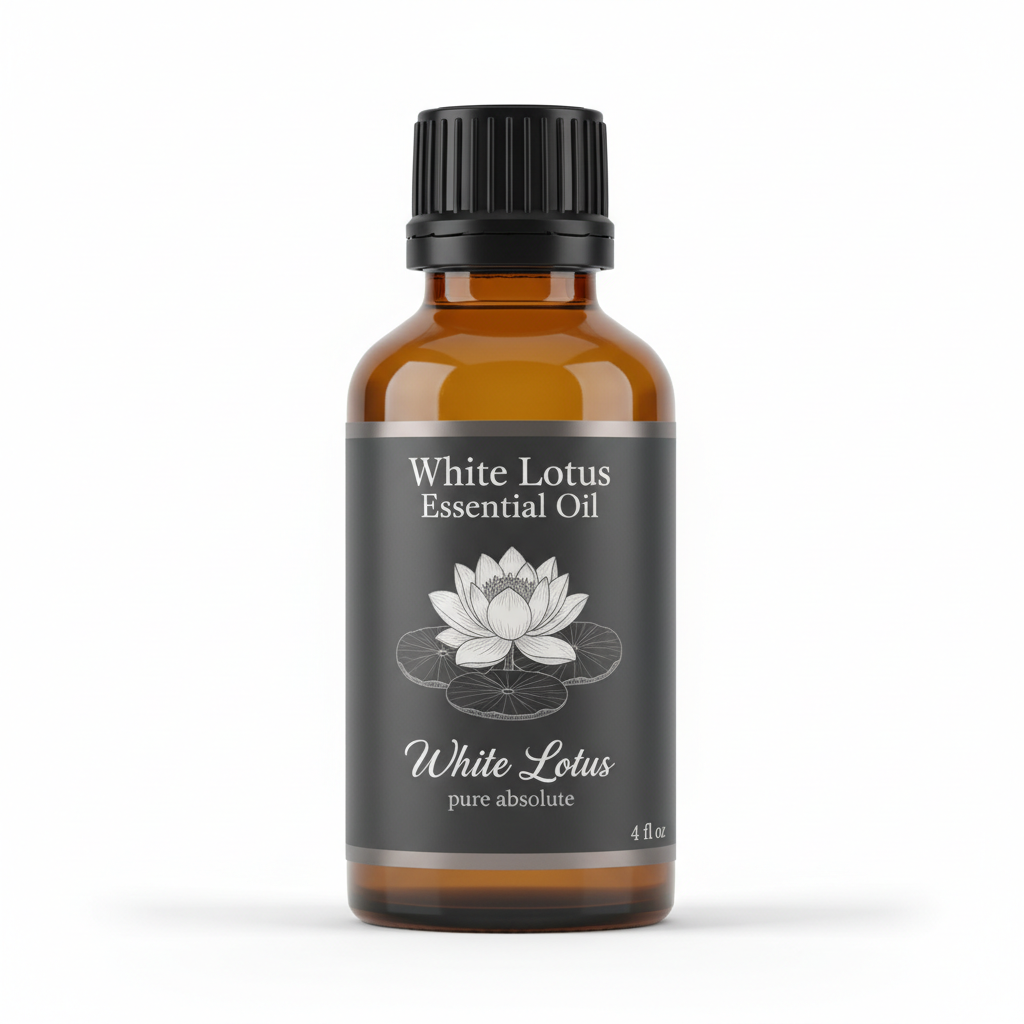
White Lotus Absolute
Our own White Lotus Absolute, in sizes from 0.5 oz to bulk.
From $23.99
Shop Now →The confusion is understandable. The lotus is embedded so deeply in human culture, spirituality, and mythology that the name alone carries enormous commercial appeal. Brands reach for it freely. But the true oil, produced through solvent extraction of fresh flowers, exists in limited supply and commands prices that reflect its rarity. Understanding what white lotus oil actually is, at a botanical and technical level, is the first step toward sourcing and using it well.
At its core, authentic white lotus oil (also called white lotus absolute or nymphaea lotus oil) is a concentrated aromatic extract. It captures the full sensory complexity of the living flower: the soft, watery freshness of the petals, the warm creamy base, the delicate green breath of the aquatic plant. No synthetic reconstruction comes close to the layered depth of the real thing. That gap in quality is precisely why it matters to know what you are buying.
This guide covers everything you need to know. We will look at the source plant and its remarkable history, explain why white lotus is technically an absolute rather than an essential oil, walk through the extraction process, explore the scent in detail, and give you practical guidance on buying, diluting, and incorporating this extraordinary oil into your rituals.
The Source Plant: Nymphaea lotus and Its Sacred Origins
Botanical Identity
Nymphaea lotus is an aquatic flowering plant in the family Nymphaeaceae. It grows rooted in the muddy beds of shallow lakes, ponds, rivers, and marshes, with broad, round floating leaves and large, showy flowers that rise just above the water surface. The flowers are typically white to pale pink, opening at night and closing in the morning. This nocturnal bloom cycle set it apart from the daytime-blooming blue lotus (Nymphaea caerulea) and contributed to its association with moonlight, mystery, and the sacred feminine in ancient cultures.
It is important to note that Nymphaea lotus is a water lily, botanically distinct from the genus Nelumbo, which contains the sacred lotus of Buddhism and Hinduism. The two plants are frequently conflated in popular writing, but they belong to entirely different plant families. If you want to understand how these species differ in scent, chemistry, and cultural significance, our detailed comparison in White Lotus vs. Pink and Blue Lotus: Telling the Waterlilies Apart covers those distinctions thoroughly.
Where It Grows
Nymphaea lotus is native to North and East Africa and is particularly associated with Egypt, where it has grown along the Nile for millennia. Today, cultivation for aromatic extraction occurs primarily in Egypt, with smaller operations in parts of India and Southeast Asia. Egyptian-sourced material is generally considered the benchmark for quality, both because of the plant's deep roots in that ecosystem and because Egyptian extraction operations have centuries of cultivated knowledge behind them.
The flowers are harvested by hand, typically in the early morning or evening when blooms are at their most fragrant. Because each flower produces a relatively small amount of extractable aromatic material, and because harvesting must be done carefully to protect petal integrity, production volumes remain low. This is not a crop that scales easily, and that fact is baked into every bottle of genuine white lotus absolute.
A History Written in Blossoms
Few plants carry as much symbolic weight as the white lotus. In ancient Egypt, Nymphaea lotus was a symbol of creation, rebirth, and the sun emerging from primordial waters. It appeared in temple carvings, tomb paintings, royal headdresses, and funerary rites. Pharaohs were depicted receiving lotus blossoms. The flower was offered to deities and placed among the wrappings of the dead as a symbol of passage and renewal.
The scented preparations made from lotus flowers in ancient Egypt were not exactly equivalent to today's absolutes, but the ambition was the same: to capture the flower's fragrance and carry it into ritual, personal adornment, and ceremony. For a full exploration of this remarkable history, see our feature on White Lotus in History: Sacred Flower of the Nile and Beyond.
This lineage matters not just as romantic backstory. It tells us something about why this particular flower's scent was worth preserving across thousands of years of human culture. It is genuinely extraordinary.
Why White Lotus Is an Absolute, Not an Essential Oil
Here is where terminology becomes critical, because the difference between an absolute and an essential oil is not merely semantic. It shapes the extraction process, the aromatic character of the finished product, and frankly, whether what you are buying is real at all.
How Essential Oils Are Made
Most familiar essential oils, think lavender, eucalyptus, peppermint, are produced by steam distillation. Plant material is exposed to steam, which carries volatile aromatic molecules up through a condenser, where they cool and separate from the water as a concentrated oil. It is an elegant, relatively affordable process that works beautifully for plant materials with robust, heat-stable aromatic compounds.
The key word there is heat-stable. Not all aromatic molecules survive the temperatures involved in steam distillation. Delicate floral compounds, particularly those found in soft, watery blossoms like jasmine, rose, and lotus, can be altered or destroyed by heat before they ever reach the condenser. What remains may be a pale shadow of the living flower's scent.
The Absolute Difference
Absolutes are produced through solvent extraction, a lower-temperature process designed specifically for fragile, heat-sensitive botanicals. The flowers are first processed with a non-polar solvent (historically hexane, though some producers use more modern alternatives) to draw out the aromatic compounds. This produces a waxy, semi-solid material called a concrete, which contains both the volatile aromatic molecules and heavier waxes and pigments from the plant.
The concrete is then processed with ethanol, which selectively dissolves the aromatic compounds and leaves the heavier waxes behind. When the ethanol is carefully evaporated, what remains is the absolute: a thick, highly concentrated, deeply fragrant liquid that represents the flower's scent with extraordinary faithfulness.
This is why white lotus cannot be a true essential oil. The flower's aromatic profile simply does not survive steam distillation intact. Any product labeled "white lotus essential oil" that claims to be a pure botanical extract deserves close scrutiny. Our dedicated deep-dive at Absolute vs. Essential Oil: Why True White Lotus Is Never a Steam Distillate explains the science in full, including what to look for on a certificate of analysis.
What This Means for the Consumer
The practical implication is straightforward. When you see "white lotus essential oil" at a low price point, you are almost certainly looking at one of the following: a synthetic fragrance oil blended to approximate the lotus scent, a carrier oil in which lotus petals have been briefly macerated (this is called an infused oil, and while pleasant, it is a very different product), or a diluted blend containing a small amount of absolute in a carrier.
None of these are fraudulent in themselves, provided the labeling is honest. But they are not equivalent to a genuine white lotus absolute, and they should not be priced or marketed as such. True white lotus absolute oil is costly, viscous, and produced in small batches. Its price reflects that reality.
| Product Type | Extraction Method | Aromatic Fidelity | Typical Price Range | Best Used For |
|---|---|---|---|---|
| White Lotus Absolute (pure) | Solvent extraction | Very high | High to very high | Fine perfumery, precious blends |
| White Lotus Absolute (diluted in carrier) | Solvent extraction + dilution | High, depending on dilution % | Moderate to high | Skincare, personal fragrance, blending |
| Lotus-Infused Carrier Oil | Cold maceration | Moderate (carrier-forward scent) | Low to moderate | General moisturising, massage |
| Synthetic Fragrance Oil | Chemical synthesis | Variable (approximation only) | Low | Candles, soaps, household fragrance |
How White Lotus Absolute Is Made
The production of white lotus absolute is a careful, labour-intensive process. Every stage shapes the quality of the finished oil, and shortcuts at any point leave a mark on the final scent.
Flower Harvesting
Harvesting begins in the field, which in the case of Egyptian white lotus means the marshy banks and cultivated ponds along the Nile delta region. Flowers are picked by hand, usually just after they have opened in the evening or in the early morning when fragrance compounds are most concentrated in the petals. Timing is not trivial. A lotus blossom that has been open for too many hours begins to change chemically, and that shift shows up in the absolute's scent.
Speed from harvest to processing is equally important. Lotus petals are delicate and begin to deteriorate quickly after picking. Most quality operations move flowers from field to extraction facility within hours. This logistical challenge is one of the reasons production remains geographically concentrated near where the plants grow.
From Blossom to Concrete
At the extraction facility, fresh petals are layered with a solvent in a closed vessel. The solvent draws out the lipophilic (fat-soluble) aromatic compounds from the plant material over a set period. The spent plant material is then removed and the solvent solution is carefully evaporated under reduced pressure and gentle heat, leaving behind the concrete: a thick, waxy, intensely fragrant semi-solid that looks something like coloured beeswax.
The concrete retains plant waxes, pigments, and other non-aromatic compounds alongside the precious fragrance molecules. It is a complete botanical extract, but not yet the finished product used in perfumery or cosmetics.
From Concrete to Absolute
The concrete is combined with high-grade ethanol and chilled, a process that causes the waxes to solidify and precipitate out of the solution. The wax is filtered away, and the remaining ethanol solution, now holding the aromatic compounds in suspension, is evaporated with great care. What is left is the absolute: a viscous, deeply coloured, intensely aromatic liquid.
White lotus absolute typically appears as a pale yellow to golden liquid with a syrupy consistency at room temperature. In cooler conditions it may become semi-solid, which is perfectly normal and not a sign of adulteration. Gently warming the bottle in your hands or in a warm water bath will return it to a pourable state.
Our detailed production feature at How White Lotus Absolute Is Made: From Nile Blossom to Bottle covers each stage with additional technical detail, including current industry standards for solvent residue limits and quality testing.
Yield and Rarity
It takes a sobering quantity of lotus blossoms to produce a small amount of absolute. Estimates vary by source and by season, but figures commonly cited by producers suggest that somewhere in the range of 500 to 1,000 kilograms of fresh flowers may be required to yield a single kilogram of absolute. When you consider that each blossom must be hand-harvested at precisely the right moment, the economics of genuine white lotus absolute become very clear. This is not a commodity. It is a craft product.
The Scent Profile: What White Lotus Actually Smells Like
Words are imperfect tools for describing scent, but they are the only ones available in written form. Here is an honest attempt at capturing the aromatic character of genuine white lotus absolute.
The Opening
The first impression of white lotus absolute on skin or on a scent strip is aquatic and green. There is a quality that perfumers sometimes describe as "watery floral": a clean, slightly humid freshness that evokes the surface of a still pond rather than a flower shop. This top note is distinctive and one of the features that makes white lotus stand apart from more conventional florals like rose or jasmine.
Alongside the aquatic opening, there is a delicate green note that suggests lily stems and fresh leaves. This is not the sharp grassiness of vetiver or the medicinal edge of some green notes. It is softer, more translucent.
The Heart
As the scent develops over the first several minutes on skin, the heart of the white lotus emerges. This is where the flower's true complexity shows itself. The aquatic freshness gives way to a warm, soft floral core with creamy, almost slightly powdery qualities. Some noses detect a faint aldehydic shimmer here, similar to what one finds in certain lily varieties. Others note a barely perceptible balsamic warmth.
The overall character is feminine and serene without being heavy or sweet. White lotus does not push forward the way tuberose or ylang-ylang can. It invites rather than announces.
The Dry Down
On the dry down, white lotus becomes warmer and more intimate. The aquatic freshness has faded, and what remains is a gentle, skin-close floral with a musky, slightly honeyed quality. This base note is what makes white lotus so valuable as a fixative ingredient in natural perfumery. It holds other notes together and extends their longevity on skin without overpowering them.
Comparing the Lotus Species
Scent is one of the key differences between the three major aromatic lotus species used in perfumery and botanical extraction. White lotus (Nymphaea lotus) is the most aquatic and clean of the three, with that characteristic watery opening. Blue lotus (Nymphaea caerulea) tends toward a more spicy, slightly earthy character. Pink lotus (Nelumbo nucifera) is often described as softer, more powdery and rose-adjacent.
If you are choosing between them for a specific application, understanding these differences is essential. Our full scent comparison at What Does White Lotus Smell Like? An Aquatic Floral Profile breaks down each note tier in greater detail and includes pairing suggestions for blending.
"Genuine white lotus absolute is one of the few natural materials that successfully bridges the gap between aquatic freshness and deep floral warmth. It is what many synthetic 'water lily' fragrances are attempting to approximate, and none quite succeed."
Natural perfumery community consensus, widely cited among artisan blenders
Uses and Applications: Perfumery, Skincare, and Atmosphere
White lotus absolute is a versatile ingredient once you understand its concentration and how to work with it. It is used across several categories, each with its own conventions and considerations.
Natural Perfumery
This is where white lotus absolute excels and where its rarity is most justified. In natural perfumery, white lotus serves several distinct roles depending on how it is used in a formula.
As a featured note, it provides that signature aquatic-floral character. Perfumers building compositions around water, purity, or ancient Egypt frequently reach for white lotus as a central pillar. It pairs exceptionally well with Egyptian jasmine, blue iris, sandalwood, soft musks, and frankincense. Amyris and cedarwood can anchor it beautifully without obscuring its delicate transparency.
As a fixative, used at lower concentrations in supporting roles, white lotus contributes to longevity and cohesion without announcing itself directly. Its warm, slightly musky base note extends the life of more volatile top notes and smooths transitions between fragrance tiers.
Usage levels in fine perfumery typically range from around 0.5 percent to 3 percent of the total formula, though this varies considerably based on the desired effect and the concentration of the specific absolute being used. Always start lower than you think necessary. White lotus is potent, and a heavy hand can tip a composition toward the heavy side of its character.
Skincare and Cosmetic Formulation
White lotus absolute has a long history of use in luxury skincare, and some research published in botanical and cosmetic chemistry literature has examined the flower's constituent compounds with interest. It is worth being precise about what this means and does not mean.
Published research on lotus flowers and their extracts has explored the presence of various compounds including flavonoids, alkaloids, and phenolic acids. Some laboratory studies have examined how these compounds interact with skin cells under controlled conditions. This research is genuinely interesting, and the findings have influenced how formulators think about lotus extracts in cosmetics.
What the research does not do is prove that applying white lotus absolute to your face will produce a specific outcome. Cosmetic formulation is complex, and the concentration of active compounds in a finished product, the bioavailability through skin, the specific formulation context, all of these variables mean that laboratory findings cannot be straightforwardly translated into guaranteed product effects.
What is well-established is this: white lotus absolute, properly diluted in appropriate cosmetic carriers, is used in luxury skincare products where it contributes beautiful scent and sits alongside other beneficial botanical ingredients. Many formulators and consumers report that lotus-rich products feel pleasant on skin and suit their routines well. That is an honest characterisation of the current state of knowledge.
In skincare formulations, white lotus absolute is typically used at 0.1 percent to 1 percent of the total formula, always diluted in a suitable carrier oil or within an emulsion. It is not applied neat to skin under any circumstances.
Atmospheric and Ritual Use
White lotus has a long association with contemplative practice, ceremonial settings, and the cultivation of calm, intentional environments. In modern use, this translates to diffusion blends, room mists, and aromatic rituals designed to create a specific atmosphere.
For diffusion, white lotus absolute should be diluted in a small amount of alcohol (such as perfumer's alcohol or high-proof ethanol) or a very light carrier oil before adding to a diffuser, as neat absolute can be too viscous and concentrated for some diffuser mechanisms. A blend of white lotus with frankincense and cedarwood in a diffuser creates a grounded, quietly ceremonial atmosphere well-suited to a bedtime wind-down or an early morning journalling session.
For room mists, a dilution of around 1 to 2 percent absolute in perfumer's alcohol with a small amount of distilled water (with appropriate emulsifier) produces a lingering, soft floral spray. Shake well before each use.
Blending Suggestions
- With frankincense and sandalwood: Creates a warm, resinous floral with a quietly sacred quality. Suited to evening rituals and meditation spaces.
- With jasmine absolute and neroli: A rich, complex white floral blend with Mediterranean warmth. Exceptional as a personal fragrance.
- With bergamot and blue chamomile: A cooler, greener floral with citrus lift. Suited to morning routines and atmospheric sprays for daytime spaces.
- With vetiver and amyris: Grounds the aquatic quality of white lotus in an earthy, woody base. Surprisingly wearable as a unisex fragrance.
- With rose absolute and ylang-ylang (used sparingly): An opulent, deeply romantic floral. Use ylang-ylang carefully as it can easily dominate.
For practical guidance on working safely with this concentrated material in your own formulations, see our step-by-step resource at How to Dilute White Lotus Absolute: Making a Precious Drop.
Buying Guide: Spotting a Genuine White Lotus Absolute
Sourcing authentic white lotus absolute requires some education and a degree of healthy scepticism. The following criteria will help you evaluate what you are looking at before you buy.
Label Terminology
A genuine white lotus absolute should carry the full INCI (International Nomenclature of Cosmetic Ingredients) name on its label or specification sheet: Nymphaea lotus flower extract or Nymphaea lotus extract. You may also see it listed as Nymphaea lotus absolute. If the label only says "white lotus fragrance oil" or "lotus essential oil" without botanical Latin, proceed with caution and ask for documentation.
Country of Origin
While lotus is cultivated in several countries, Egyptian-origin material is most closely associated with the traditional aromatic use of Nymphaea lotus. Indian and Southeast Asian sources also exist and can produce fine material, but Egyptian provenance from Nile-region cultivation is considered the heritage standard. A reputable supplier should be able to tell you where their material originates.
Certificate of Analysis
Serious suppliers of natural aromatic materials provide a certificate of analysis (CoA) for each batch of absolute they sell. This document should include GC/MS (gas chromatography/mass spectrometry) data, which provides a fingerprint of the aromatic compounds present in the material. Authentic lotus absolute has a recognisable chemical profile. If a supplier cannot or will not provide a CoA, that is a significant red flag.
Key compounds identified in genuine white lotus absolute through GC/MS analysis typically include various sesquiterpenes, benzyl alcohol, linalool, and other characteristic floral volatiles. An absolute with a suspiciously simple or unfamiliar chemical profile may warrant further questions.
Appearance and Consistency
Pure white lotus absolute is a viscous, syrupy liquid at room temperature. Its colour ranges from pale yellow to light amber or golden, occasionally with a very faint greenish tint from chlorophyll. It should not be clear and thin like water, nor should it be deeply dark brown or black. If the material pours as freely as water or has an unexpected colour, investigate further before purchasing.
Some suppliers offer white lotus absolute pre-diluted to a percentage (commonly 3 percent, 5 percent, or 10 percent) in jojoba oil or another carrier. This is legitimate and practical, particularly for personal use, but the price and application rates should reflect the dilution. A 3 percent dilution is not equivalent to a 100 percent absolute, and should not be priced as one.
Price as a Signal
This is blunt but necessary: if the price seems too good to be true, it almost certainly is. Genuine white lotus absolute is among the most expensive aromatic materials by weight. Prices per gram for pure absolute are comparable to or exceed high-quality rose absolute and jasmine absolute. A large bottle of "white lotus essential oil" priced at a few dollars is not, and cannot be, the genuine article.
Paying a high price does not automatically guarantee authenticity, but paying a very low price almost certainly guarantees inauthenticity. Use price as an initial filter, then follow up with documentation requests.
Reputation of the Supplier
Established natural perfumery suppliers with transparent sourcing practices, active relationships with producer communities, and willingness to share batch-specific documentation are your safest sources. Look for suppliers who discuss their supply chains openly, acknowledge the limitations of their knowledge honestly, and do not make exaggerated claims about their products.
| Evaluation Criteria | What to Look For | Red Flags |
|---|---|---|
| Botanical name on label | Nymphaea lotus clearly stated | No Latin name, vague "lotus extract" only |
| Country of origin | Egypt (preferred), India, or clearly stated source country | Origin not disclosed or unavailable |
| Documentation | GC/MS certificate of analysis available per batch | No CoA available, or generic document not batch-specific |
| Appearance | Viscous, golden to pale amber, slight floral-watery aroma | Clear and watery, or very dark, or synthetic-smelling |
| Price | Reflects rarity and labour intensity of production | Suspiciously low for the volume offered |
| Supplier transparency | Open about sourcing, limitations, and extraction method | Vague, evasive, or makes extraordinary claims |
Safety, Dilution, and Responsible Use
White lotus absolute is a concentrated botanical material and must be handled accordingly. The following guidance reflects general best practice for working with absolutes and plant extracts. It is not a substitute for consultation with a qualified aromatherapist, cosmetic chemist, or healthcare provider for your specific circumstances.
Always Dilute Before Skin Contact
White lotus absolute should never be applied to skin in its undiluted (neat) form. At full concentration it may cause sensitisation or irritation, even in individuals who tolerate diluted material without issue. This is true of virtually all absolutes and concentrated botanical extracts, regardless of how natural or gentle they sound.
For cosmetic and personal fragrance use, recommended dilution levels are as follows:
- Leave-on face products (serums, facial oils): 0.1 to 0.5 percent in carrier oil or emulsion
- Leave-on body products (body oils, lotions): 0.5 to 1 percent in carrier
- Personal fragrance (perfume oil or cologne): 1 to 3 percent in perfumer's alcohol or jojoba oil
- Rinse-off products (bath oils, shower gels): Up to 1 percent, noting that rinse-off reduces exposure time
These percentages refer to pure white lotus absolute in the finished product. If you are starting with a pre-diluted absolute (such as a 10 percent dilution in jojoba), adjust your calculations accordingly.
Patch Testing
Before using any new aromatic ingredient on a broader area of skin, conduct a patch test. Apply a small amount of your diluted preparation to the inner forearm or behind the ear. Wait 24 to 48 hours and observe the area for any redness, itching, or other signs of sensitivity. If any reaction occurs, discontinue use and consult a healthcare provider.
A previous tolerance of a product does not guarantee ongoing tolerance. Sensitisation can develop over time with repeated exposure, particularly to concentrated botanical materials. This is not a reason to avoid natural aromatics, but it is a reason to use them thoughtfully and at appropriate dilution levels.
Populations Requiring Special Caution
- Pregnancy and nursing: The safety of many essential oils and absolutes during pregnancy and breastfeeding has not been systematically studied. If you are pregnant, nursing, or planning to become pregnant, consult your midwife, obstetrician, or a qualified aromatherapy practitioner before using concentrated botanical extracts.
- Children: Children's skin is more permeable and their sensitivity profiles differ from adults. Concentrated aromatics should not be used on infants or young children without professional guidance, and even then, at considerably reduced concentrations.
- Known plant allergies: Individuals with known sensitivities to plants in the Nymphaeaceae family should approach white lotus absolute with particular caution and may wish to avoid it entirely.
- Individuals on medication: If you are taking any prescribed or over-the-counter medications, consult a qualified healthcare provider before adding concentrated botanical extracts to your routine. Some compounds in botanical extracts may interact with medications in ways that are not fully characterised.
Storage
White lotus absolute, like most natural aromatic materials, degrades with exposure to heat, light, and oxygen. Store your absolute in a tightly sealed amber or dark glass bottle, away from direct sunlight and heat sources. A cool, dark cupboard is ideal. Properly stored white lotus absolute can retain its aromatic character for two to three years, though quality-conscious users will note gradual changes over time. If the scent shifts significantly toward a rancid or fermented character, the material has degraded and should be retired from use on skin.
Solvent Residue: A Note on Extraction
A common concern about solvent-extracted absolutes is the possible presence of residual extraction solvent in the finished product. This is a legitimate question, and reputable producers and suppliers address it through rigorous testing. Industry standards specify maximum permitted levels of residual solvents in cosmetic-grade absolutes, and well-produced material from established suppliers consistently meets or exceeds these standards.
When you source from a transparent supplier who provides batch-specific CoA documentation, you have the means to verify that the material you are using meets accepted safety standards. This is one of the strongest arguments for buying from established, documentation-forward suppliers rather than chasing bargain pricing.
For a practical walkthrough of how to work with white lotus absolute at home, including measuring tiny quantities of a viscous material and building your first dilution, see our beginner-friendly guide at How to Dilute White Lotus Absolute: Making a Precious Drop.
A Note on the FDA Disclaimer
White lotus absolute and other botanical aromatic extracts are cosmetic and aromatic materials. They are not drugs, and the information in this guide does not constitute medical advice. Always consult a qualified healthcare provider regarding any questions about your health, and never substitute aromatic products for professional medical care.
Bringing It All Together
White lotus oil, in its genuine form as a solvent-extracted absolute of Nymphaea lotus, is one of the most extraordinary aromatic materials available to the natural perfumer, the thoughtful skincare formulator, and the curious consumer who values botanical authenticity. It carries thousands of years of cultural significance, an incomparable scent profile that no synthetic can fully replicate, and a rarity that makes each drop genuinely precious.
Understanding what it is at a technical and botanical level, knowing how to identify the real thing, working with it safely and at appropriate dilutions, and appreciating the history embedded in its scent: all of this transforms white lotus absolute from a mere ingredient into something closer to an experience.
The world of aromatic botanicals rewards patience and education. White lotus, perhaps more than any other single ingredient, exemplifies why that investment of attention is worthwhile. Take your time with it. Smell it on a warm strip, then on skin. Trace the development through opening, heart, and dry down. Consider how it might anchor a personal fragrance, elevate a facial oil, or transform the atmosphere of a quiet evening at home.
Then, when you are ready to go deeper, explore the related guides in this series. Each one illuminates a different facet of this remarkable flower and the extraordinary oil it yields.
- What Does White Lotus Smell Like? An Aquatic Floral Profile
- Absolute vs. Essential Oil: Why True White Lotus Is Never a Steam Distillate
- How White Lotus Absolute Is Made: From Nile Blossom to Bottle
- White Lotus in History: Sacred Flower of the Nile and Beyond
- White Lotus vs. Pink and Blue Lotus: Telling the Waterlilies Apart
- How to Dilute White Lotus Absolute: Making a Precious Drop