
White Lotus Absolute vs. Lotus Fragrance Oil: Most Bottles Are Fake
Here is an uncomfortable truth about the lotus oil market: the majority of products sold under the name "lotus oil" contain no lotus whatsoever. Not a single petal. What fills those amber bottles is typically a blend of synthetic aroma chemicals, carrier oils, and occasionally other florals that happen to share a vague olfactory resemblance to the real thing. If you have ever purchased a "white lotus fragrance oil" and felt quietly disappointed by how flat or chemical it smelled, you were not imagining it. You were simply smelling the truth.
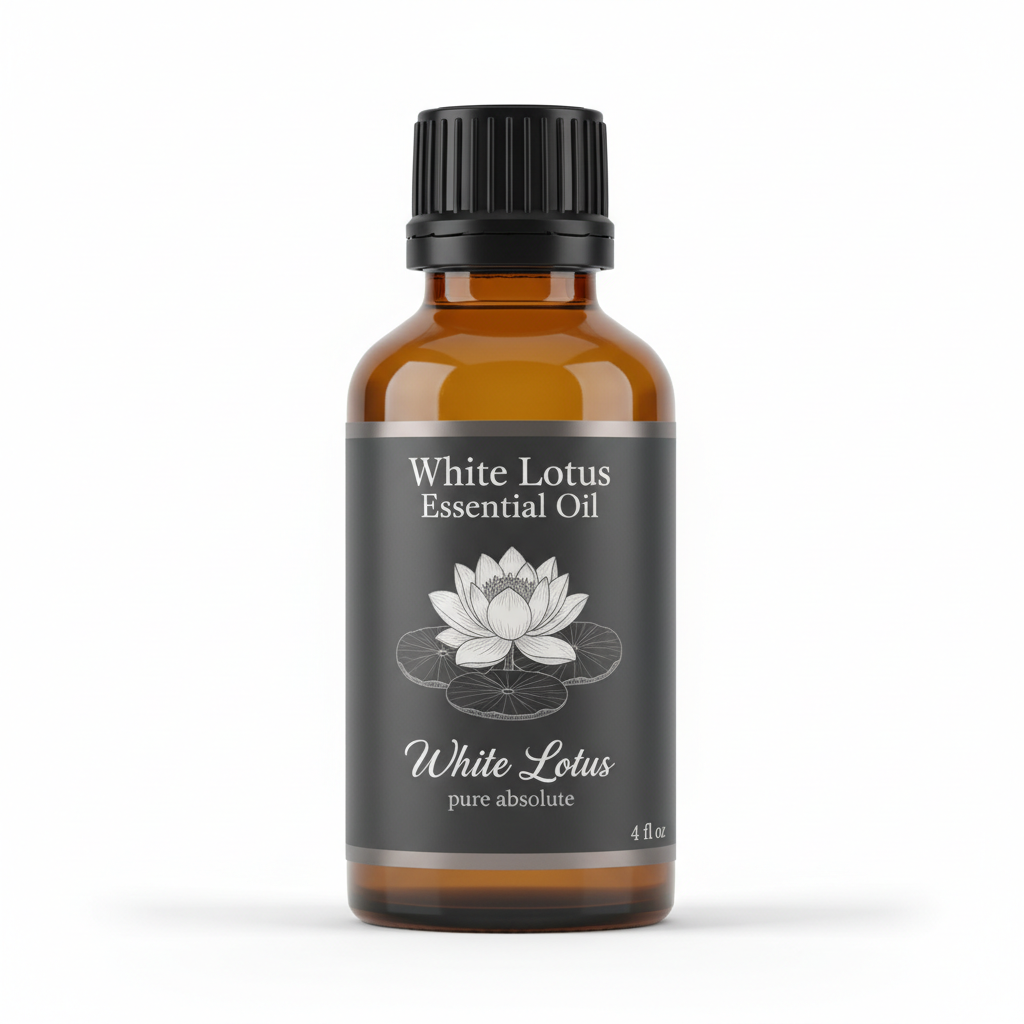
White Lotus Absolute
Our own White Lotus Absolute, in sizes from 0.5 oz to bulk.
From $23.99
Shop Now →This article separates myth from fact across the most common misconceptions buyers encounter. Understanding the difference between genuine white lotus absolute and synthetic lotus fragrance oil is not just an academic exercise. It matters for your skin, your blending practice, and your wallet.
Why the Lotus Oil Market Is So Confusing
White lotus (Nymphaea lotus or Nymphaea ampla, depending on the botanical origin) does not yield its aromatic compounds easily. The extraction process requires either solvent extraction to produce an absolute or CO2 supercritical extraction, and both are labor-intensive. Genuine white lotus absolute is produced in relatively small quantities, primarily in Egypt and parts of South Asia, and the supply chain is short. Demand, however, is enormous.
The gap between supply and demand creates the perfect conditions for substitution. Fragrance manufacturers fill that gap with synthetic reconstructions, which are far cheaper to produce, infinitely scalable, and consistent batch to batch. None of that is inherently dishonest, as long as the product is labeled accurately. The problem is that labeling accuracy is frequently absent.
For a deeper look at sourcing and purchasing genuine material, the guide on how to buy white lotus absolute: the complete authenticity guide covers verification steps in detail.
Myth 1: "If It Says Lotus Oil, It Contains Lotus"
The Myth
A product labeled "lotus oil," "lotus essential oil," or "white lotus fragrance oil" must contain some portion of actual lotus extract. Why else would it carry that name?
The Fact
Cosmetic and fragrance labeling regulations in most markets do not require a product to contain an ingredient simply because that ingredient appears in the product name. A "lotus fragrance oil" is legally a fragrance compound. It smells (or is intended to smell) like lotus. It is not required to contain lotus-derived material.
Evidence from industry insiders and independent quality testing consistently indicates that the overwhelming majority of mass-market lotus oils are fully synthetic reconstructions. Some contain traces of related florals such as ylang ylang or jasmine, added to approximate a floral character. A small number contain lily or magnolia extracts. Very few contain actual Nymphaea extract of any kind.
Why This Myth Persists
Consumers reasonably expect that a product name reflects its contents. The fragrance industry has operated on a different logic for decades, where "fragrance oil" describes a format (oil-soluble aromatic compound) rather than an ingredient list. Unless you read the full INCI listing or request a certificate of analysis, there is no way to know what you are actually buying from the label alone.
Myth 2: "Essential Oil" and "Absolute" Both Mean Natural"
The Myth
Both "essential oil" and "absolute" are natural products extracted from plants. They are fundamentally the same thing, just different names for the same category.
The Fact
These are distinct extraction categories with meaningful differences, and white lotus does not produce a true steam-distilled essential oil at commercial scale.
Essential oils are typically obtained through steam distillation or cold expression. The heat and water involved in steam distillation can damage the delicate aromatic profile of certain flowers, including lotus. Absolutes are obtained through solvent extraction: the plant material is first processed with a solvent to create a waxy "concrete," and then the concrete is washed with alcohol to yield the absolute. This cold process preserves more of the original floral complexity.
What this means practically: if you see a product labeled "white lotus essential oil" at a low price point, scrutiny is warranted. Genuine white lotus material comes as an absolute or a CO2 extract. A steam-distilled "white lotus essential oil" at $15 per bottle is almost certainly a fragrance oil or a diluted synthetic in a carrier, mislabeled.
Why This Myth Persists
The terms "essential oil" and "absolute" are used interchangeably in casual conversation, and many consumers have never been given a reason to learn the distinction. Sellers who want to position a synthetic product as natural sometimes adopt essential oil terminology because it carries a perceived quality signal.
Myth 3: "Fragrance Oils Are Just Inferior Versions of Real Oils"
The Myth
Fragrance oils are cheap knockoffs. They are always lower quality, and any serious aromatics user should avoid them entirely.
The Fact
This myth swings too far in the opposite direction. Fragrance oils are not inferior by definition. They are a different category of product, designed for different applications, and they have legitimate uses.
High-quality synthetic fragrance oils produced by reputable fragrance houses can be extraordinarily sophisticated. The issue is not that they exist. The issue is misrepresentation. A fragrance oil sold honestly as a "lotus-inspired fragrance blend" for use in candles, diffusers, or soap making serves its purpose well. A fragrance oil sold as "100% natural white lotus essential oil" is a different matter entirely.
For cosmetic formulation, particularly leave-on skin products, the distinction matters more. Genuine white lotus absolute carries the botanical lipid and ester profile of the flower. Synthetic fragrance compounds may include ingredients that are not appropriate for certain skin types, and the IFRA (International Fragrance Association) guidelines for fragrance compounds differ from the usage parameters for botanical absolutes.
Why This Myth Persists
The natural products community sometimes frames the conversation as "natural good, synthetic bad," which oversimplifies. That framing causes buyers to either distrust all fragrance oils categorically or, conversely, to assume that any product with a natural-sounding label must be the real thing.
Myth 4: "Real Lotus Oil Is Clear and Liquid"
The Myth
Genuine lotus oil should be clear, pale, and freely pourable, just like most essential oils you see in a store.
The Fact
Authentic white lotus absolute is typically a viscous, semi-solid to thick liquid material. Its color ranges from pale amber to golden yellow, and it may become even more solid at cooler room temperatures. If you gently warm the vial in your hands, it will loosen.
A product that pours freely like water at room temperature and appears completely colorless is almost certainly not a pure lotus absolute. It is either heavily diluted in a carrier oil (which is legitimate, as long as that dilution is disclosed) or it is a synthetic fragrance oil that mimics what buyers expect to see.
The viscosity of genuine lotus absolute comes from the natural waxes, esters, and heavier aromatic compounds that survive the extraction process. These are part of what makes it useful in perfumery and cosmetic formulation. Removing them, as happens with heavy dilution or synthetic substitution, removes part of the material's character.
Why This Myth Persists
Most consumers first encounter essential oils through eucalyptus, peppermint, or lavender, all of which are thin, freely flowing liquids. This creates an unconscious standard. When a genuine floral absolute behaves differently, buyers sometimes assume something is wrong with the product.
Myth 5: "Price Is Not a Reliable Indicator of Quality"
The Myth
Price means nothing in this industry. You can find quality products at every price point. Expensive does not mean better.
The Fact
Price is not a guarantee of quality, but it is a reliable signal of impossibility. Genuine white lotus absolute cannot be produced at the price points common in the mass market. The cost of raw material, labor, solvent extraction equipment, and quality testing establishes a realistic floor below which authenticity is not possible.
Research into lotus production economics suggests that pure white lotus absolute, uncut and undiluted, will always carry a significant price premium relative to common essential oils. A 5 ml bottle priced comparably to a 5 ml bottle of lavender should prompt immediate questions. Lavender is one of the most efficiently produced aromatic crops in the world. Lotus is not.
This does not mean every expensive lotus product is authentic. It means that every very cheap one almost certainly is not. Price is a necessary but not sufficient condition for authenticity.
For further comparison of how white lotus absolute is positioned relative to other luxury florals, the articles on white lotus vs. jasmine absolute and white lotus vs. rose absolute offer useful context on market pricing and quality benchmarks.
Why This Myth Persists
The "price does not equal quality" principle is genuinely sound in many consumer categories. Buyers rightly apply it to skincare, clothing, and food. In the botanical extract market, however, raw material economics create a different dynamic. Dismissing price entirely can lead buyers to rationalize purchases that common sense would otherwise flag.
How to Tell the Difference: Practical Checks
Beyond the myths, here is what to actually look for when evaluating a lotus oil product.
- Request a GC/MS report. A gas chromatography/mass spectrometry report identifies the chemical constituents of the oil. Genuine white lotus absolute has a recognized constituent profile. A reputable supplier will provide this documentation without hesitation.
- Check the INCI name. The correct INCI listing for white lotus absolute is Nymphaea Lotus Flower Extract or Nymphaea Lotus Absolute, depending on the product form. "Fragrance" or "parfum" in the INCI indicates a synthetic compound.
- Observe viscosity and color. As noted above, genuine absolute is thick and amber-toned. Watery and colorless is a red flag.
- Smell critically. Authentic white lotus absolute has a soft, aquatic-floral quality with depth and some slightly green or aldehydic nuance. Synthetic versions often read as louder, sweeter, or more straightforwardly "clean" in a way that can feel flat rather than complex.
- Ask about origin. Lotus absolute with a verifiable source region (Egypt, India) and a named producer or distiller is significantly more credible than a product with no traceable supply chain.
A Note on Diluted Absolutes
Not every product that contains a carrier oil is fraudulent. Many reputable suppliers offer white lotus absolute pre-diluted in jojoba or fractionated coconut oil, typically at 3 to 10 percent concentration, to make it more accessible for direct skin application and blending. This is a legitimate product format.
The key requirement is disclosure. A diluted absolute should clearly state the concentration and the carrier used. If a product simply says "white lotus oil" with no mention of dilution or carrier, and it is priced at a mass-market level, the absence of disclosure is itself informative.
The Bottom Line
The white lotus fragrance oil category is flooded with synthetic reconstructions, mislabeled dilutions, and outright misrepresentation. That does not mean genuine white lotus absolute is impossible to find. It means finding it requires more than a quick search and a low price filter.
Approach every lotus oil purchase as a small investigation. Ask for documentation. Read the INCI listing. Understand what the material should look, smell, and behave like before you buy. Fake lotus oil sells so successfully because buyers do not know what the real thing is supposed to be. Now you do.