
Dupes and Diluted Drops: How Cheap White Lotus Oils Cut Corners
White lotus absolute is one of the most labor-intensive botanicals on earth. The flowers open at night, last only a few days, and must be harvested by hand in the pre-dawn hours before the fragile petals collapse. None of that sounds like the backstory of a $12 oil. Yet cheap white lotus oil listings flood online marketplaces, each one promising the same rare floral splendor at a fraction of the honest price.
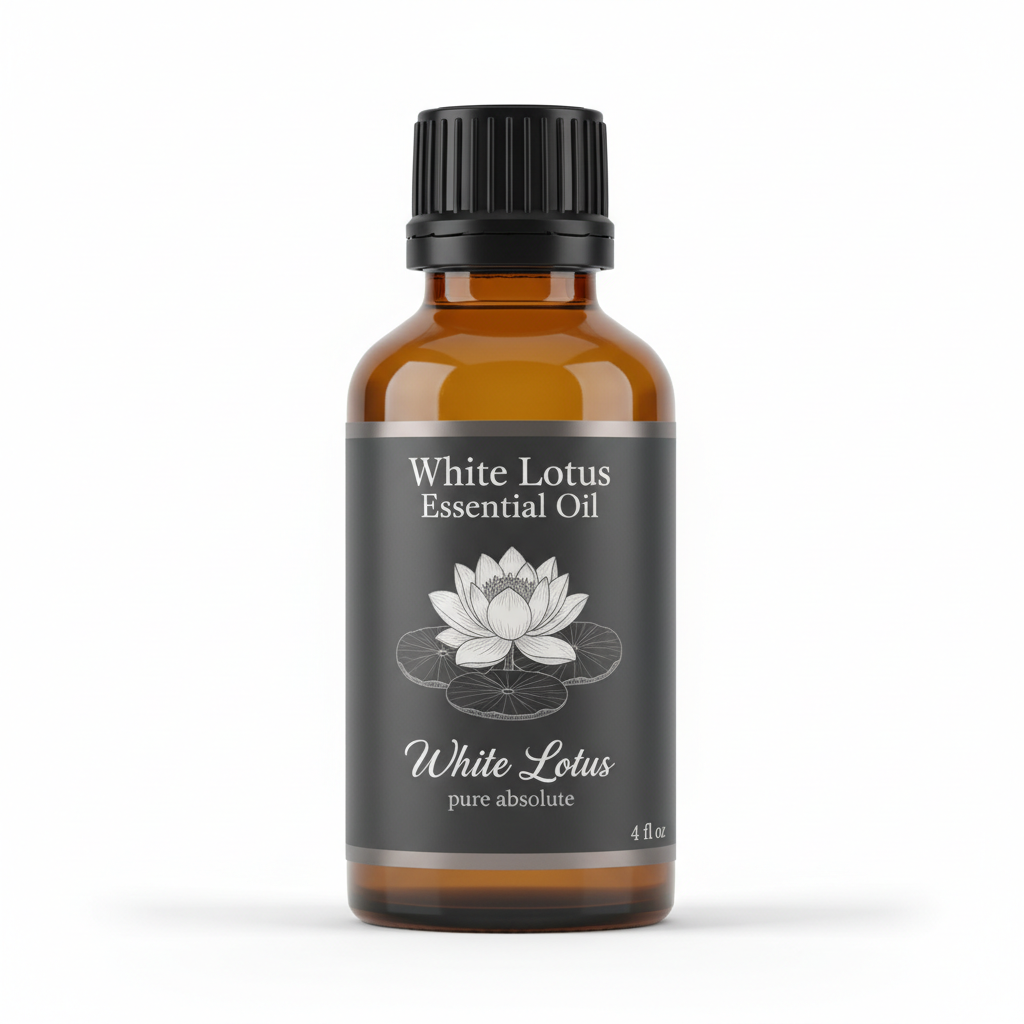
White Lotus Absolute
Our own White Lotus Absolute, in sizes from 0.5 oz to bulk.
From $23.99
Shop Now →This article is for anyone who has wondered why prices vary so wildly, or who suspects a recent purchase smells a little off. Below, we walk through the most common myths circulating about lotus oil quality, pricing, and sourcing, and set the record straight with context drawn from botanical extraction science and supply-chain evidence.
Why the Myths Exist in the First Place
The lotus oil market has a transparency problem. Unlike, say, lavender, which has well-established regional benchmarks and gas chromatography (GC) data that buyers can reference easily, white lotus absolute sits in a smaller, less-regulated niche. Most retail buyers have never smelled a genuinely high-grade lotus absolute before purchasing their first bottle. That knowledge gap is exactly where corner-cutting thrives.
Sellers exploit unfamiliarity in two directions. Some market diluted lotus absolute as full-strength product. Others sell synthetically blended or reconstituted fragrances, labeling them with language vague enough to avoid outright fraud while still misleading a casual buyer. Understanding the specific myths that prop up these practices is the first step toward protecting your investment. For a broader look at the purchasing landscape, our guide on how to buy white lotus absolute covers authentication from start to finish.
Myth 1: "All White Lotus Oils Are Basically the Same"
The claim: Lotus is lotus. Brand names and higher prices are just marketing. A cheap white lotus oil delivers the same experience as an expensive one.
The Truth
The variation between genuine white lotus absolute and a diluted or synthetic version is not subtle. It is dramatic.
True Nymphaea lotus or Nymphaea caerulea absolute is solvent-extracted from fresh flowers and then further refined. The resulting material is typically a viscous, deeply colored concentrate with a scent profile that research suggests contains dozens of volatile aroma compounds, including linalool, benzyl benzoate, and various sesquiterpenes. These compounds interact in ways that a single synthetic aroma chemical cannot replicate.
Cheap white lotus oil often relies on a single dominant synthetic, most commonly a musky floral isolate or a reconstituted blend built around inexpensive aromatic bases. Side by side, the difference is apparent: a genuine absolute has depth, a green-aquatic top note, a warm powdery heart, and a slow, resinous dry-down. A synthetic dupe typically smells flat, sharp on opening, and fades quickly on skin.
The myth persists because most buyers do not have a reference point. If the first lotus oil you ever smell is a dupe, you have nothing to compare it against.
Myth 2: "If It Says 'Lotus Absolute' on the Label, It Must Be Pure"
The claim: The word "absolute" on a label is a guarantee of authenticity and purity. Labeling laws protect buyers from mislabeling.
The Truth
Labeling conventions for botanical extracts in the fragrance and cosmetic ingredient space are far looser than most buyers assume. In many jurisdictions, there is no legal requirement to disclose the percentage of actual botanical extract in a finished blend. A product labeled "white lotus absolute" may legally contain a small fraction of genuine lotus absolute diluted in a carrier, or blended with synthetic aromatic materials, as long as some lotus absolute is technically present.
Evidence from cosmetic ingredient audits and industry fragrance testing indicates that diluted lotus absolute is common across lower price tiers. The dilution may happen at the supplier level, the distributor level, or both. By the time a bottle reaches a retail shelf or an online listing, tracing its actual concentration requires third-party GC/MS (gas chromatography/mass spectrometry) testing that most buyers will never commission.
What to look for instead: reputable suppliers will voluntarily provide a GC/MS report or a Certificate of Analysis (CoA) on request. If a vendor cannot or will not supply documentation, that silence is itself informative. Our detailed breakdown of why white lotus absolute costs so much explains the economics that make transparency both possible and worth demanding.
Myth 3: "A Lower Price Just Means the Seller Has Lower Overhead"
The claim: Small online sellers skip the middleman and pass savings along. A $15 lotus oil from a home-based seller is just as good as a $90 bottle from an established supplier.
The Truth
Overhead explains some price variation. It does not explain 80 percent differences in cost per milliliter.
The raw material cost of genuine white lotus absolute at the wholesale level is already high. Research into botanical extraction yields suggests that solvent extraction of lotus flowers produces a relatively small quantity of absolute per kilogram of fresh flower material. Harvest labor, solvent costs, refining, and quality-control testing all layer on top of that base cost before a single bottle is filled.
A seller with genuinely low overhead still faces the same raw material floor. When a price drops well below that floor, something in the product has changed. The most common explanations are: the absolute has been heavily diluted in a carrier oil (fractionated coconut oil and jojoba are the most popular choices); the product contains little or no actual lotus absolute and is primarily a synthetic fragrance blend; or the botanical source is a different, cheaper species being passed off as the premium variety.
Lotus oil dupes built on synthetic aromatic bases can be manufactured for pennies per milliliter. That is where the dramatic price compression originates. It has nothing to do with lower overhead and everything to do with a fundamentally different product.
Myth 4: "Dilution in Carrier Oil Is Fine, as Long as You Know About It"
The claim: Diluted lotus absolute is just pre-diluted for convenience. If the seller is upfront about it, there is nothing wrong with buying it.
The Truth
Dilution itself is not inherently a problem. Diluting a genuine absolute in a quality carrier is a legitimate and practical step, especially for skin application. The problem is undisclosed dilution sold at undiscounted prices, and the broader confusion it creates about what lotus absolute should smell and perform like.
When a pre-diluted product is sold without clear disclosure of its concentration, buyers lose the ability to make meaningful comparisons. A 3 percent dilution in jojoba is a very different purchase from a neat absolute, and the price should reflect that difference substantially. Industry evidence suggests that pre-diluted lotus products are frequently priced as if they were near-neat concentrates, particularly in the lotus oil dupes segment of online marketplaces.
If you are comparing products and one is clearly disclosed as a 5 percent dilution, that context allows you to evaluate value honestly. The issue is not dilution; it is the absence of honest disclosure. Always ask for the percentage of absolute in any pre-diluted product before purchasing.
Myth 5: "You Can Spot a Fake by Smell Alone"
The claim: Anyone with a good nose can tell a genuine lotus absolute from a dupe. Experienced users will always catch low-quality products.
The Truth
Smell is a useful starting point. It is not a reliable endpoint.
High-quality lotus oil dupes built from sophisticated reconstituted fragrance blends can be difficult to distinguish by nose alone, particularly for buyers who have not had extensive exposure to verified genuine material. Some synthetic lotus bases are designed specifically to mimic the green-aquatic-floral signature of the real absolute, and they do so convincingly enough to mislead even experienced fragrance enthusiasts on first encounter.
Viscosity is a better quick indicator than scent alone. Genuine white lotus absolute is typically quite viscous at room temperature and may need gentle warming to pour. A thin, water-like oil claiming to be a neat absolute is almost certainly diluted or synthetic. Color is a secondary indicator: genuine lotus absolute ranges from amber to deep orange-brown depending on the batch. A nearly colorless product labeled as neat absolute warrants scrutiny.
The gold standard remains GC/MS documentation. For anything beyond small personal-use quantities, requesting a third-party test report is a reasonable and increasingly common ask. Suppliers who work with serious formulators and perfumers expect this request and accommodate it readily.
How to Protect Your Purchase
The myths above share a common thread: they all benefit sellers who are cutting corners, not buyers who are spending money. Correcting the information asymmetry is the most practical form of protection available.
- Ask for documentation. Request a GC/MS report or Certificate of Analysis before purchasing. Reputable suppliers provide these without hesitation.
- Check the price against honest benchmarks. If a price seems too low to cover the raw material cost of genuine lotus absolute, it probably is. Our price guide for white lotus absolute gives you a realistic framework.
- Assess viscosity and color. Neat lotus absolute is thick and richly colored. A thin, pale product sold as neat concentrate is a warning sign.
- Clarify dilution status upfront. Ask directly whether the product is a neat absolute or a pre-diluted blend, and at what percentage.
- Buy in smaller quantities first. If you are evaluating a new supplier, a small initial purchase lets you assess quality before committing to a larger volume. Our article on the best white lotus sizes explains why this approach makes sense for lotus in particular.
A Note on What Genuine Lotus Absolute Is For
White lotus absolute is used in perfumery, cosmetic formulation, and personal aromatic rituals. Its value lies in its complexity and its origin: a flower harvested under precise conditions, processed with care, and bottled with integrity intact. When a cheap white lotus oil replaces that reality with a fragrance shortcut, it does not just cost you money. It costs you the actual experience you were seeking.
Knowing how corner-cutting happens is the clearest path to avoiding it. The lotus market will always have dupes as long as buyers remain unfamiliar with what genuine material looks, smells, and costs. Closing that knowledge gap is what separates a satisfying purchase from an expensive disappointment.